Make a Referral Make a Referral
Header Text

News

Stay up to date with the latest news affecting older people in Auckland and across Aotearoa.


At Age Concern Auckland, we curate relevant articles, updates, and stories on topics like elder wellbeing, healthcare, housing, community services, and policy changes. Check back regularly for fresh content that matters to seniors, their whānau, and caregivers.

READ MORE
15 Apr

New AI assistant for fast, easy problem reporting

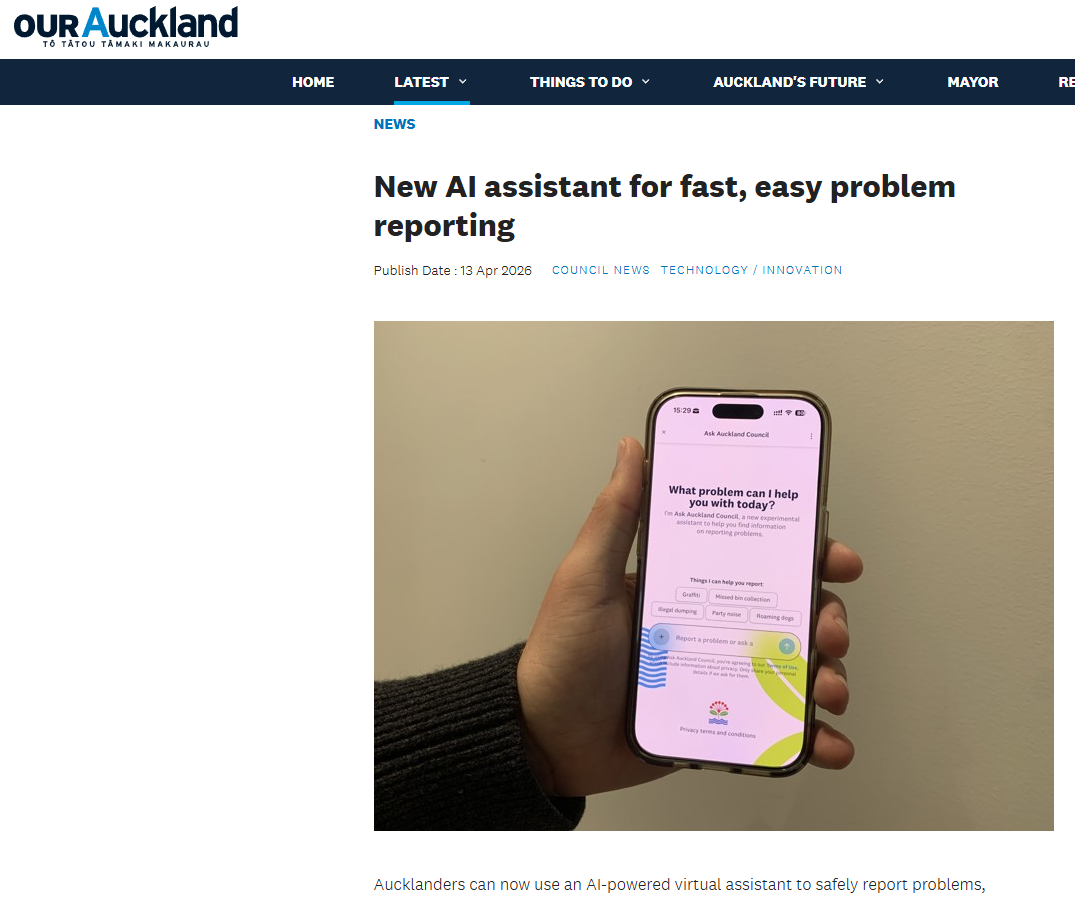
Aucklanders can now use an AI-powered virtual assistant to safely report problems, including graffiti, roaming dogs and party noise.

Every day, Aucklanders help keep our communities safe, neighbourly and tidy by reporting problems to the council. This has just got easier with the launch of a new, purpose-built virtual assistant called Ask Auckland Council.

You can use it to report graffiti, illegal dumping, roaming dogs, missed bin collections, and party/people noise, as well as quickly find information for reporting other problems.

More problem categories will be added over the coming months. Meanwhile, the council is working on speeding up internal processes so that reported problems can get fixed faster.

Ask Auckland Council is an AI assistant which you can access on your smartphone, computer, tablet or any device via a web browser. Find the link on the main Report a problem page on the Auckland Council website or access the assistant directly.


Read more
READ MORE
14 Apr

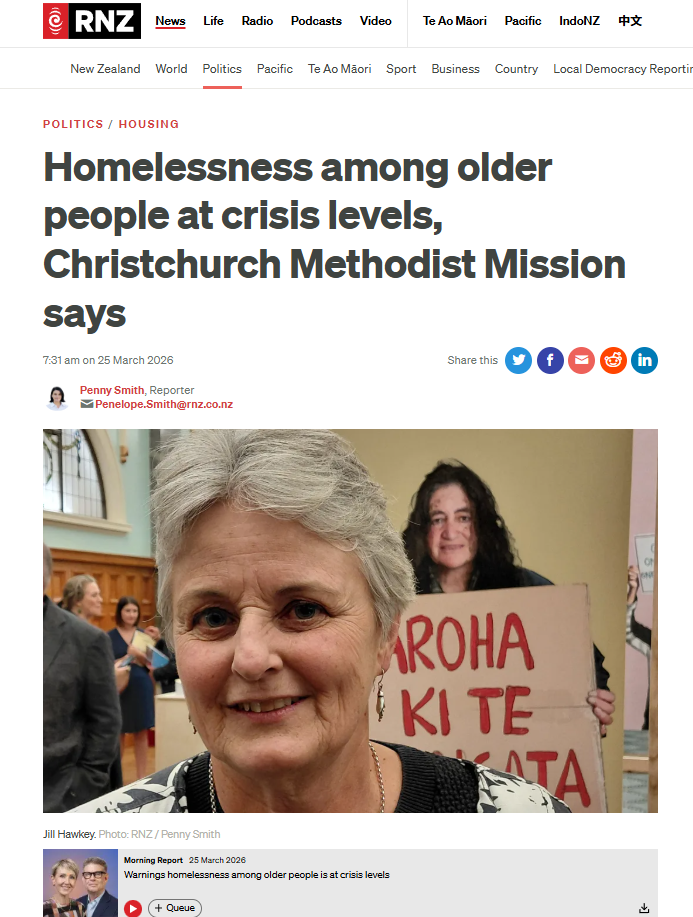
Homelessness among older people at crisis levels, Christchurch Methodist Mission says

The Christchurch Methodist Mission is warning that homelessness among older people is at crisis levels and that the situation is rapidly worsening.

The scale of the problem was laid bare during the launch of the charity's cross-party Doors to Dignity campaign at Parliament on Tuesday night.

The mission said the housing situation for older New Zealanders had deteriorated significantly over the past five years.

Its executive director Jilll Hawkey said that, anecdotally, the number of older people rough sleeping was on the rise.

"We see it from our housing outreach teams, we've in recent weeks found a couple of women in their eighties who have been homeless and two men last week in their sevenites who are homeless," she said.


Read more
READ MORE
13 Apr

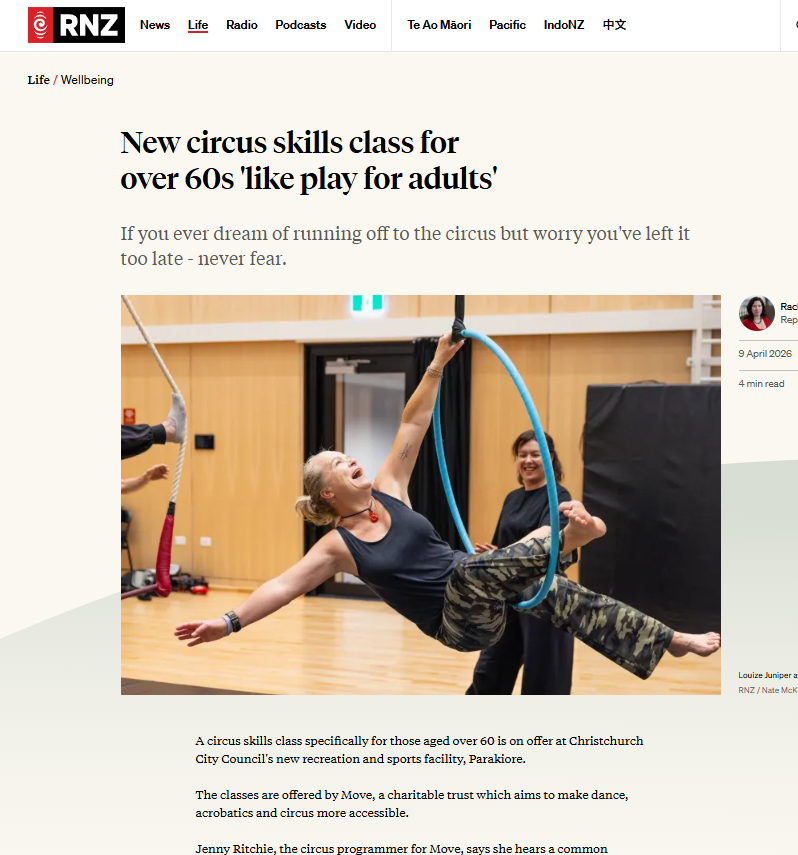
New circus skills class for over 60s 'like play for adults'

A circus skills class specifically for those aged over 60 is on offer at Christchurch City Council's new recreation and sports facility, Parakiore.

The classes are offered by Move, a charitable trust which aims to make dance, acrobatics and circus more accessible.

Jenny Ritchie, the circus programmer for Move, says she hears a common refrain from people when they first arrive at the class.


Read more
READ MORE
13 Apr

What Is The Tech Helping Seniors Live Independently At Home For Longer?

This from Scoop: Across the world, populations are ageing at an unprecedented rate, both as a result of medical advances and a decrease in birth rates. The forecast is alarming, estimating that by 2080, there will be more individuals aged 65 and over than people under the age of 18. The global population aged 65+ is projected to reach 2.2 billion by 2080, which outnumbers the number of children. 

As a result, ageing at home is becoming not just a preference, but a necessity. Fewer working-age individuals will be available to support the growing number of seniors, which places pressure on healthcare systems and caregiving networks. How can we make life at home as a senior safe and sustainable without sacrificing independence? 


Read more
READ MORE
7 Apr

New elder abuse assessment tool to help health workers spot warning signs

A tool for health workers to detect elder abuse has been developed by the University of Auckland.

Lead researcher Kathy Peri said the tool would aid health providers in identifying whether elderly people show signs of possibly being abused.

In New Zealand, Elder Abuse Response Services received 2852 reports of abuse from Age Concern in 2022 to 2023, with an average of 11 new cases reported every workday.

However, Peri, a senior lecturer in nursing, said the figures could be the tip of the iceberg because many elderly people are reluctant to report abuse or neglect by a loved one.


Read more
READ MORE
31 Mar

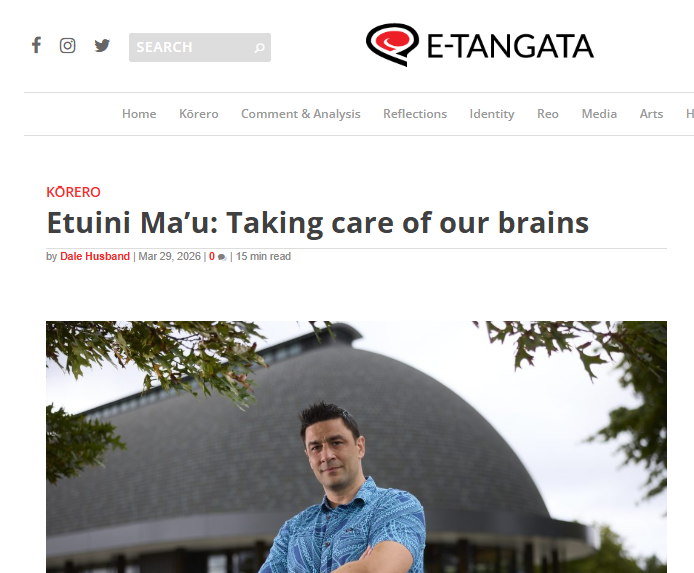
Etuini Ma’u: Taking care of our brains

This from E-Tangata: “Brain health isn’t something that we only worry about in old age. We need to be thinking about brain health all through our lives.” — Dr Etuini Ma‘u, old age psychiatrist, dementia researcher, and senior lecturer in psychological medicine at Auckland University. (Photo: Mark Hamilton)

With the number of over-65-year-olds in Aotearoa set to hit the million mark by 2029, many of us will already know someone with dementia. It’s a sure bet, too, that we’ll be coming across the work of Dr Etuini Ma‘u, an old age psychiatrist, dementia researcher, and senior lecturer in psychological medicine at the University of Auckland.

Here he is talking to Dale Husband, about why we should be thinking about our brain health now.


Read more
READ MORE
31 Mar

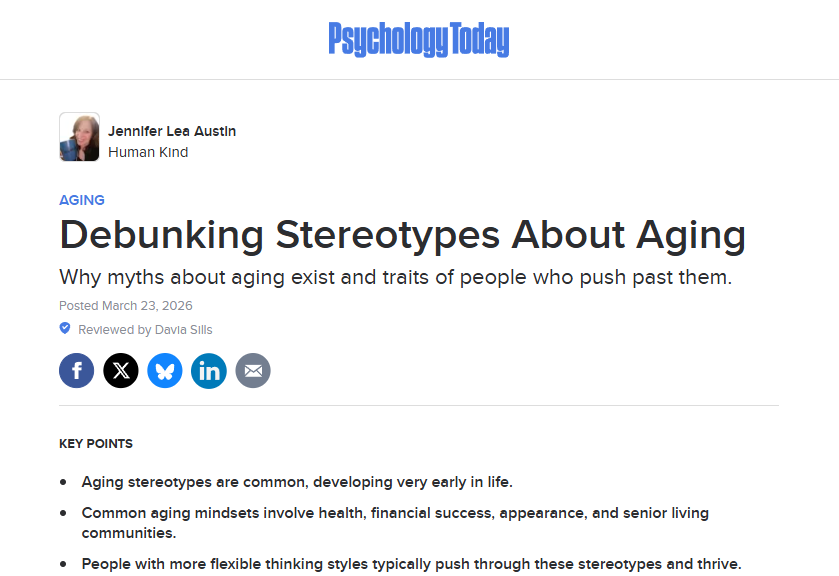
Debunking Stereotypes About Aging

Key points

  • Aging stereotypes are common, developing very early in life.
  • Common aging mindsets involve health, financial success, appearance, and senior living communities.
  • People with more flexible thinking styles typically push through these stereotypes and thrive.


Read more
READ MORE
30 Mar

The 'Mind' diet could help keep your brain sharp as you age

Scientists have been quietly building a case that what you eat in midlife shapes your brain decades later. This is what the evidence actually shows.


The Mediterranean diet – rich in olive oil, fish, vegetables and legumes – has long been linked to better heart health. Growing evidence suggests it may also help support brain health as we age, with a brain-focused variation of the diet drawing increasing scientific attention.

It is called the Mind diet. The name stands for Mediterranean-Dash Intervention for Neurodegenerative Delay – though what matters more than the acronym is what it actually involves: plenty of green vegetables, beans, whole grains, nuts, berries, poultry and fish, with olive oil as the main cooking fat, and limited amounts of red meat, butter, cheese, fried food and sweets. It combines the most brain-friendly elements of two well-studied eating patterns: the traditional Mediterranean diet and the Dash diet, which was originally developed to lower blood pressure.


Read more
READ MORE
27 Mar

Age Concern Auckland helps seniors enhance their digital literacy

A Digital Literacy Programme in east Auckland has taken off with “remarkable momentum”, transforming curiosity into confidence for a growing group of older learners.

The final session of the course run by Age Concern Auckland is being staged today, March 27, from 1.30pm to 3pm at Botany Library.

Age Concern Auckland’s social connections co-ordinator, Shalini Gulani, says: “What began with just 13 participants quickly expanded to 20 within a week, as word spread about the programme’s supportive and energising environment.

“Over the course of six weeks, participants were guided through the fundamentals of smartphone use.

“Sessions covered essential skills such as adjusting settings, connecting to wi-fi, using hotspots and Bluetooth, making calls, and sending messages.


Read more
READ MORE
25 Mar

Age Concern responds to government fuel relief package

Critics say the government's cost-of-fuel relief package won't help some of the most vulnerable New Zealanders. Yesterday, the government announced almost 150 thousand New Zealand families would receive up to $50 dollars a week through the in-work tax credit to help with soaring petrol prices. Age Concern Auckland CEO Kevin Lamb.


Read more
READ MORE
16 Mar

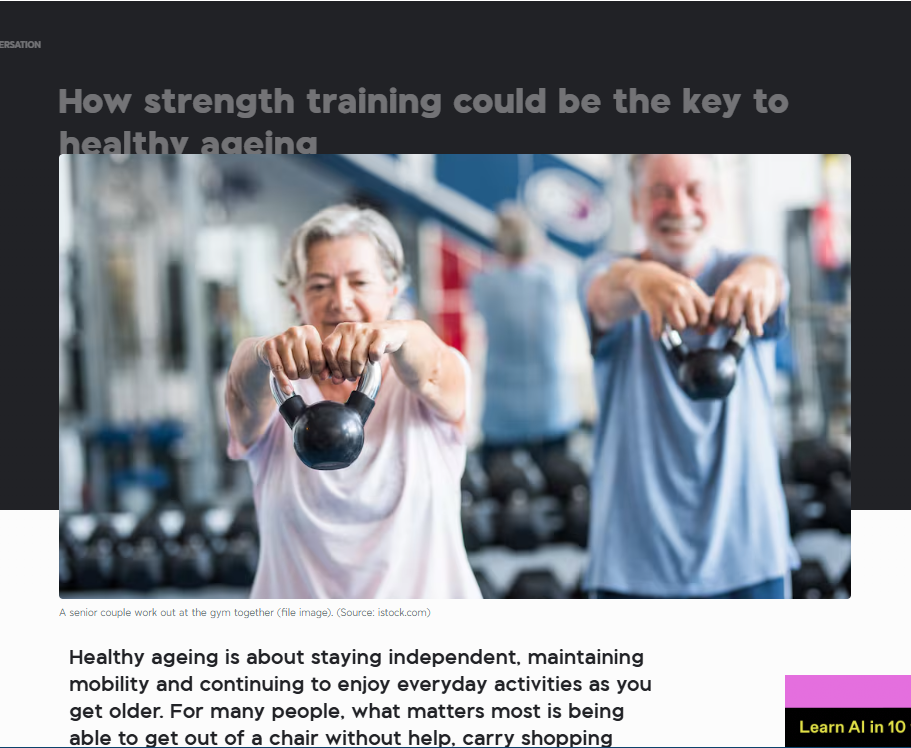
How strength training could be the key to healthy ageing

One news: Healthy ageing is about staying independent, maintaining mobility and continuing to enjoy everyday activities as you get older. For many people, what matters most is being able to get out of a chair without help, carry shopping home, climb the stairs and recover quickly after illness.By Christopher Hurst for The ConversationOne of the most important and well-established factors in healthy ageing is muscle strength. Sarcopenia, the age-related loss of muscle mass and strength, leads to reduced physical function and mobility.Over time, muscles become smaller and weaker. This matters because muscle does more than move our limbs: it stabilises joints, supports balance and acts as a reserve during illness or injury.As muscle strength declines, the risk of falls and fractures increases, particularly in later life. Estimates suggest that sarcopenia affects a substantial proportion of older adults, particularly those over the age of 70.


Read more
READ MORE
16 Mar

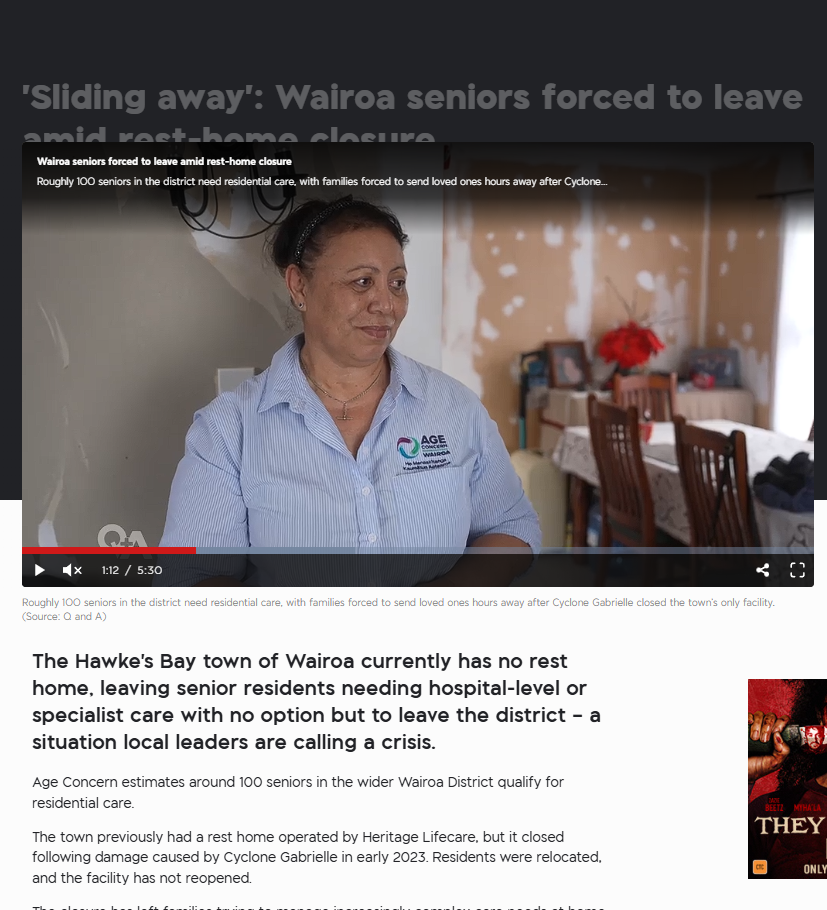
'Sliding away': Wairoa seniors forced to leave amid rest‑home closure

This from One News: The Hawke's Bay town of Wairoa currently has no rest home, leaving senior residents needing hospital-level or specialist care with no option but to leave the district – a situation local leaders are calling a crisis.

Age Concern estimates around 100 seniors in the wider Wairoa District qualify for residential care.

The town previously had a rest home operated by Heritage Lifecare, but it closed following damage caused by Cyclone Gabrielle in early 2023. Residents were relocated, and the facility has not reopened.

The closure has left families trying to manage increasingly complex care needs at home.

Tricia Cotton is caring for her 88-year-old father, Koroua, who lives with dementia, while also working full-time.


Read more
READ MORE
13 Mar

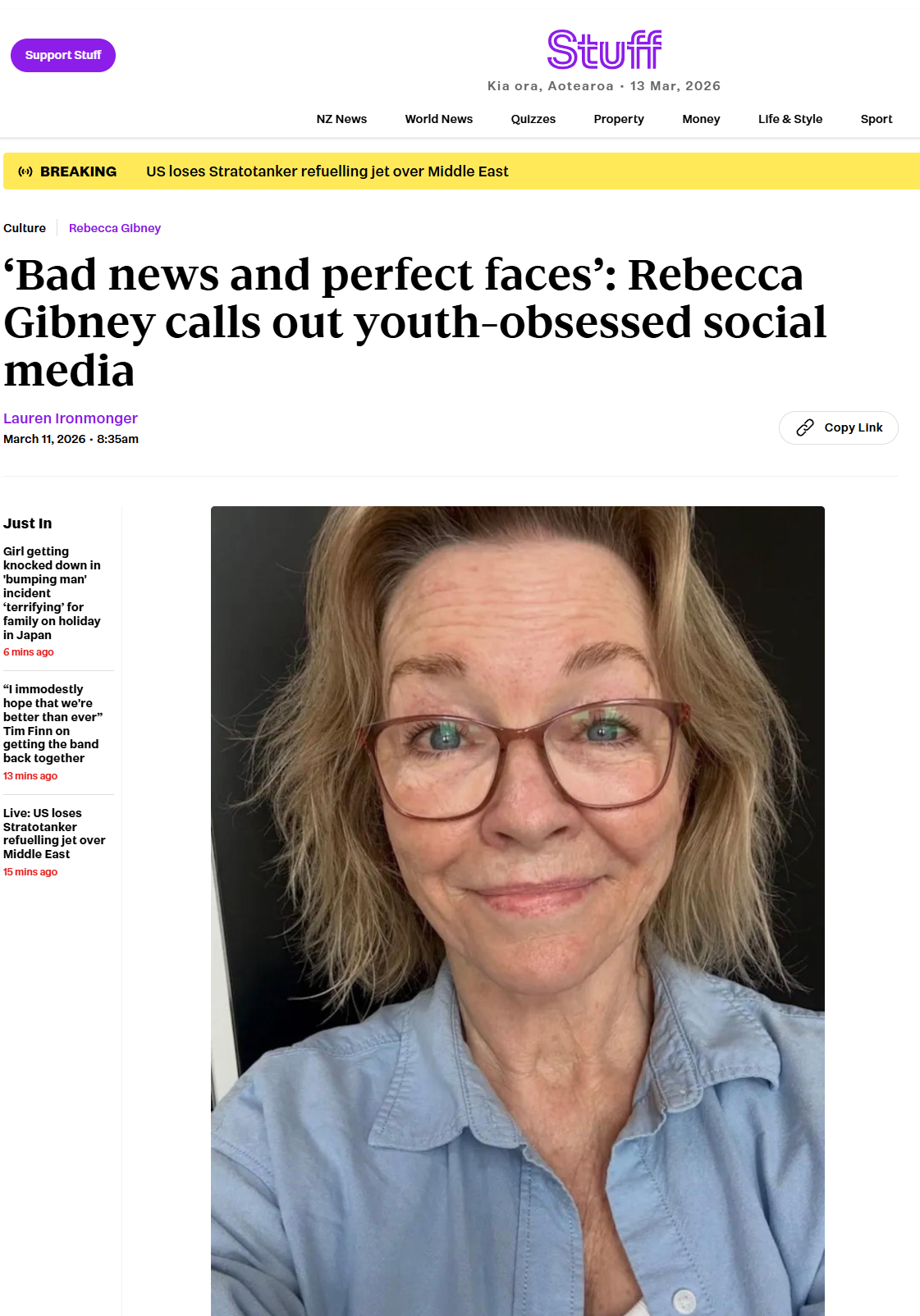
‘Bad news and perfect faces’: Rebecca Gibney calls out youth-obsessed social media

In an endless scroll of filtered, gravity-defying faces, New Zealand actor and TV presenter Rebecca Gibney has fought back in an Instagram post.

“Scrolling thru social media all I see is bad news, AI rubbish or perfect photoshopped lives. Then I came to images of@rachelwardofficial and I breathed a sigh of relief,” the 61-year-old wrote yesterday morning.

“I thought I might add my unfiltered sun damaged face and my funny old cowl lick fringe and fine over processed hair to the mix.”


Read more
READ MORE
12 Mar

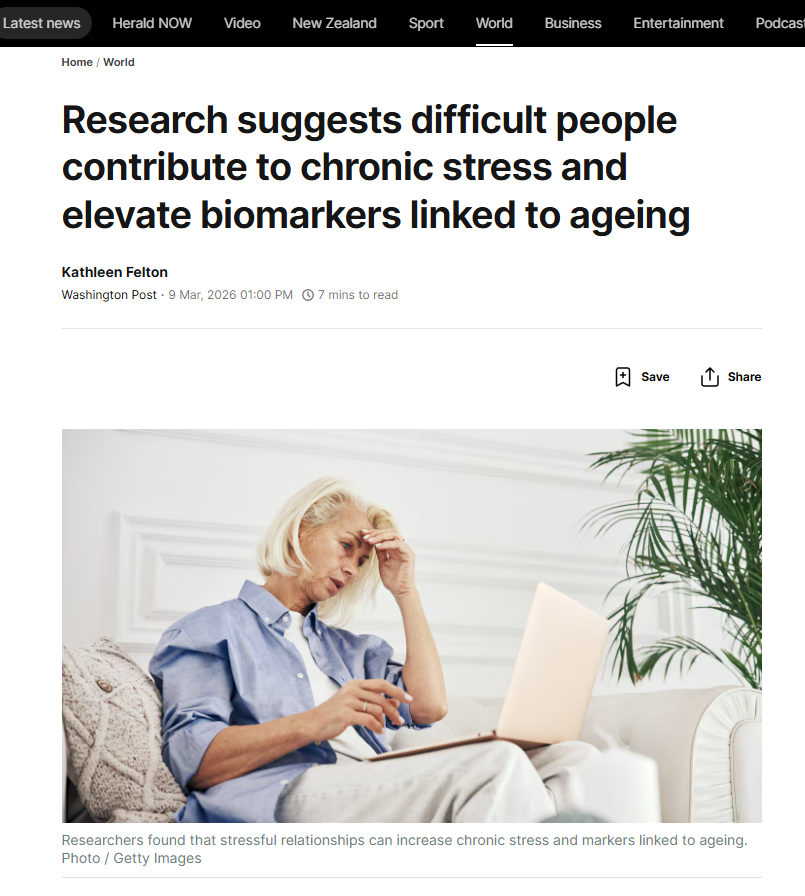
Research suggests difficult people contribute to chronic stress and elevate biomarkers linked to ageing

This from the Hearald: Spending time with a difficult person can impact your mood in the moment. But over time, these challenging social interactions might also have a detrimental effect on your physical health, possibly making you age faster, new research suggests.

The study, which was funded by the National Institute on Ageing and published in Proceedings of the National Academy of Sciences, looked at the health impacts of “hasslers” – people the researchers defined as those “who create problems or make life more difficult”.

While positive relationships have long been linked to healthier, longer lives, hasslers seem to have the opposite effect, increasing chronic stress and elevating epigenetic biomarkers associated with ageing.


Read more
READ MORE
10 Mar

'Grey washing': SuperGold Card discounts skip entire regions

SuperGold Card holders are finding it difficult to cash-in on weekly supermarket discounts with a mish-mash of locations, leaving some regions missing out entirely with patchy coverage in others.

Age Concern chief executive Kevin Lamb called it an example of "grey washing".

For example, the SuperGold Card was accepted at grocery stores in most central business districts, but not in Gisborne, Marlborough Nelson, Tasman, West Coast districts nor the densely populated Auckland CBD, with a fast-growing resident senior population of more than 2000 people.

"It is portraying themselves as supporting older people, but doing what I would call the bare minimum in order to achieve that," Lamb said.

"If you're going to say that SuperGold Card gets a discount in our stores, why wouldn't you do that for every store? Not just cherry pick a handful of stores around the country and have such a lack of consistency about where those stores are located."


Read more
READ MORE
5 Mar

History In Making As Governments Draft A Legally Binding Treaty For Rights Of Older Persons

Scoop World brings this story: This is indeed a historic first when governments come together to draft a legally binding possible treaty to protect the human rights of older persons. The first ever historic Inter Governmental Working Group (IGWG) meeting to protect the rights of older persons was held recently. IGWG was created by the UN Human Rights Council in April 2025 and given the mandate to draft a legally binding UN Convention on the Rights of Older Persons.


Read more
READ MORE
19 Feb

Changing the NZ Super age won’t fix the country's retirement system problems on its own, panel says at New Zealand Economics For

Interest.co.nz posted this story: Labour leader Chris Hipkins says there’s big questions for us as a country about how we fund superannuation in the long-term, but raising the age of eligibility isn’t one of those questions.

His comment comes after a panel discussion at the New Zealand Economics Forum in Hamilton last week, where the panel spoke about whether the system could keep up, the age of retirement, life expectancy, and potential tweaks and their impacts on the economy and future generations.

Facilitator and former politician Steven Joyce, ANZ chief economist Sharon Zollner, Milford Asset Management chief executive Blair Turnbull, Barrister and former politician David Parker, and Aged Care Association chief executive and former politician Tracey Martin made up the panel.


Read more
READ MORE
17 Feb

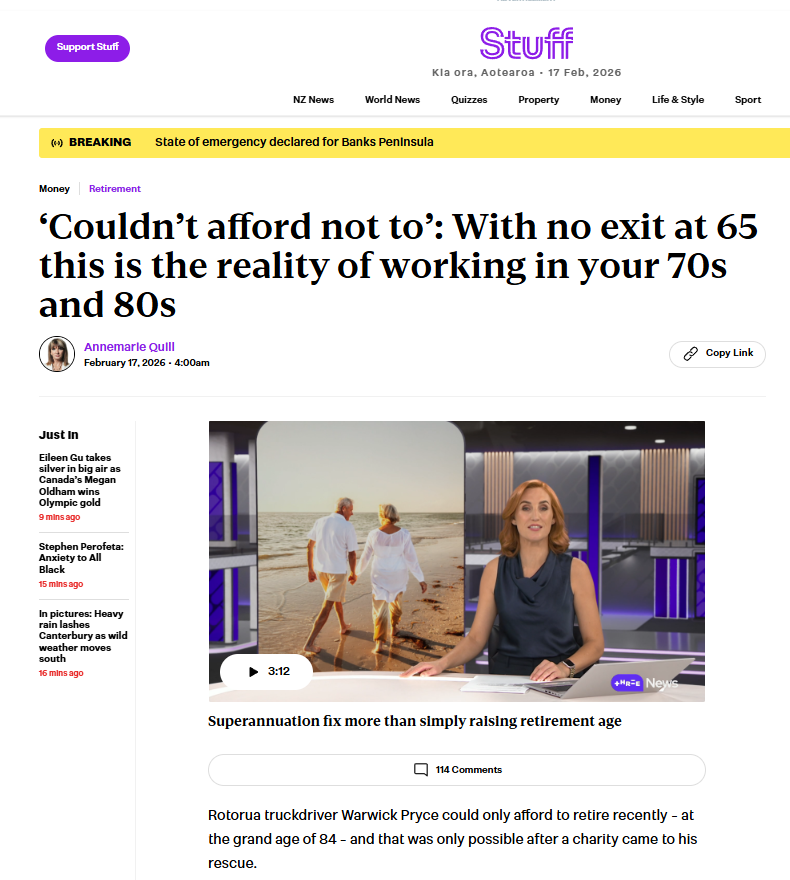
‘Couldn’t afford not to’: With no exit at 65 this is the reality of working in your 70s and 80s

Rotorua truckdriver Warwick Pryce could only afford to retire recently - at the grand age of 84 - and that was only possible after a charity came to his rescue.

“My rent is now half what it was, so I was able to give up work. I was sick of being bounced around on a truck every morning.

Pryce is a mechanic, but has spent the last few years working as a truck driver, getting up before sunrise to transport fertiliser from Rotorua to Kawerau and back, every day.

He’d carried on working because he “couldn’t afford not to”.


Read more
READ MORE
17 Feb

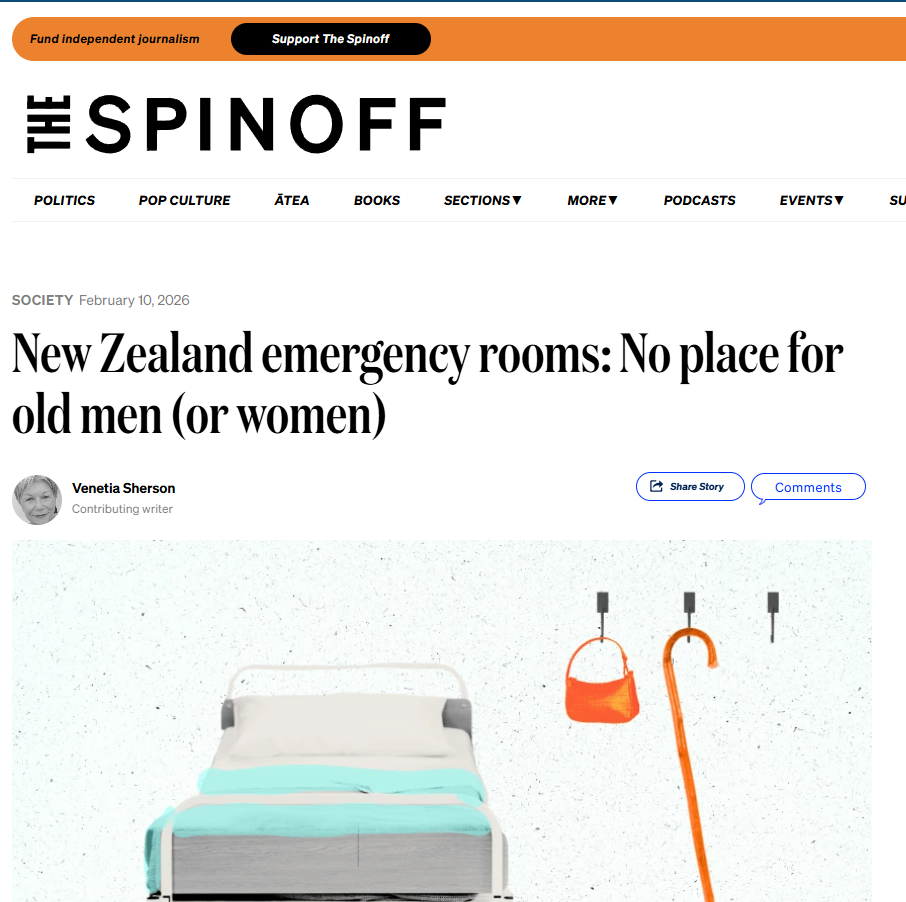
New Zealand emergency rooms: No place for old men (or women)

From the Spinoff: Older people are arriving at hospital emergency departments in greater numbers than ever before, compounding the problems of long wait times and poor health outcomes for those who are frail. Is there a better way? Yes, say two New Zealand hospitals. Is the government listening? 

At Waikato Hospital’s emergency department on a Tuesday afternoon, a woman is curled in a foetal position across two stiff-backed hospital chairs designed to be durable and easy to clean, but that are uncomfortable if you are in pain. She moans quietly, then louder, holding her stomach as the spasm peaks. She looks like a woman in labour but is far too old to be giving birth. And this is not a delivery suite.

A man in flannelette pyjamas and a bathrobe sits hunched over in a wheelchair. The young woman with him, who may be his granddaughter, offers him a paper cup of water.  She tries to bring the flaps of his pyjama pants together to cover his genitals. He doesn’t seem aware of the exposure.


Read more
READ MORE
13 Feb

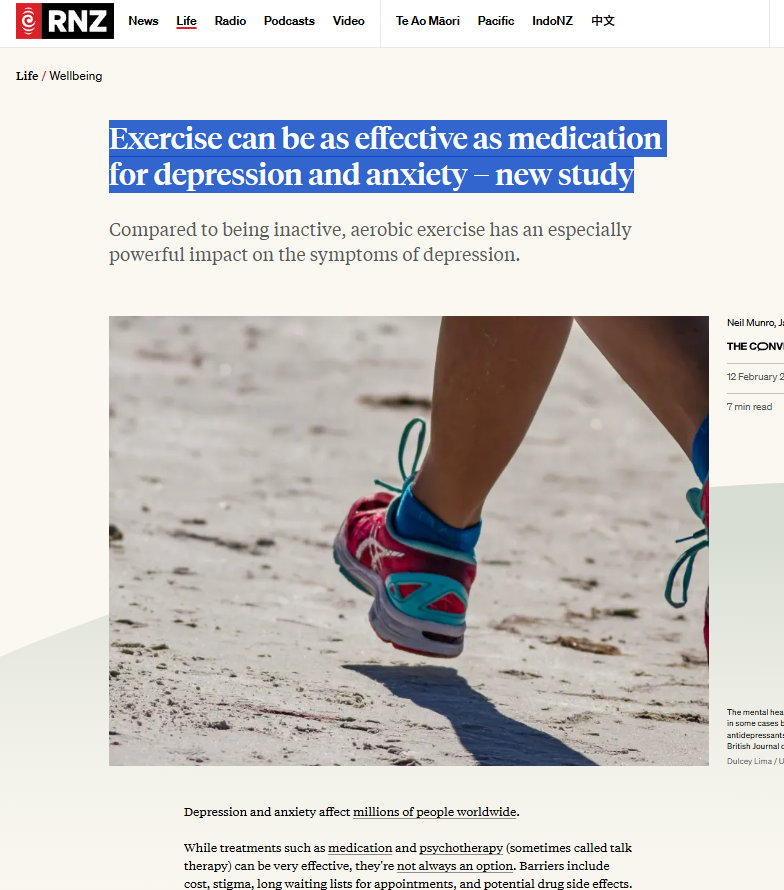
Exercise can be as effective as medication for depression and anxiety – new study

This story by RNZ: Compared to being inactive, aerobic exercise has an especially powerful impact on the symptoms of depression.
Neil Munro, James Dimmock and Klaire Somoray for12 February 20267 min readCaption:The mental health benefits of exercise are comparable to and in some cases better than those of talk therapy and antidepressants, according to a new study published in the British Journal of Sports Medicine.Photo credit:Dulcey Lima / Unsplash

Depression and anxiety affect millions of people worldwide.

While treatments such as medication and psychotherapy (sometimes called talk therapy) can be very effective, they're not always an option. Barriers include cost, stigma, long waiting lists for appointments, and potential drug side effects.


Read more
READ MORE
13 Feb

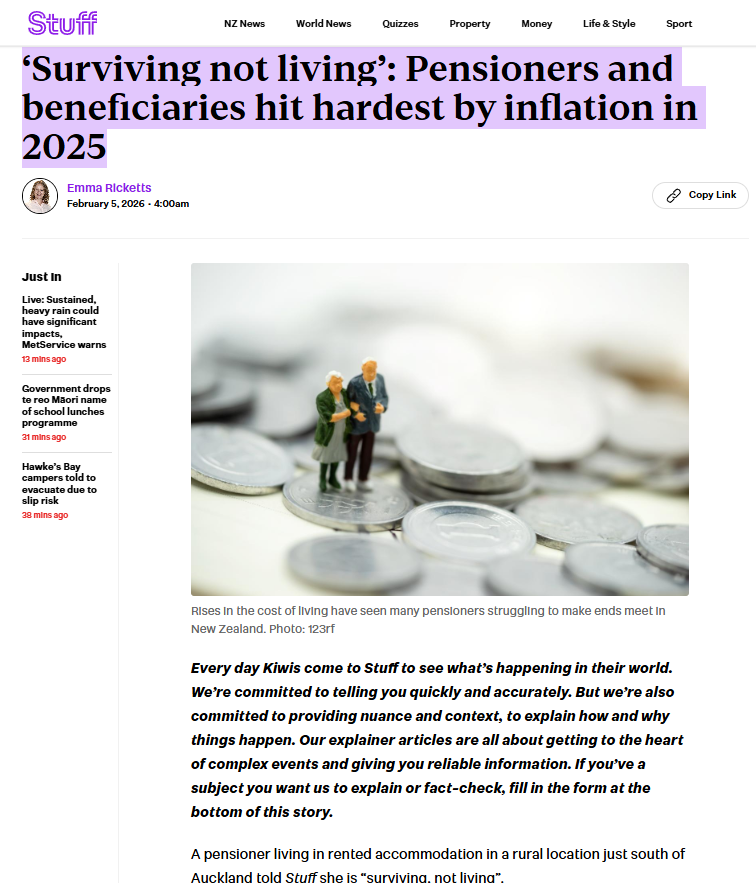
‘Surviving not living’: Pensioners and beneficiaries hit hardest by inflation in 2025

Shared from Stuff: A pensioner living in rented accommodation in a rural location just south of Auckland told Stuff she is “surviving, not living”.

Paula*, 68, has been retired for three years. She relies entirely on her pension and an accommodation supplement to pay the bills.

Over those three years, keeping up with the cost of living has become noticeably harder, she says.
While New Zealand super rates do keep pace with inflation, any increase to Paula’s pension is counted as extra income by Work and Income. That means every adjustment results in a decrease to her accommodation supplement, she says, so she doesn’t end up with any extra money.

Since Paula retired, inflation has increased by more than 10%. So, in essence, she’s taken a 10% pay cut over that time.

“I feel like [the Government] is giving with one hand and taking away with the other,” she said.


Read more
READ MORE
5 Feb

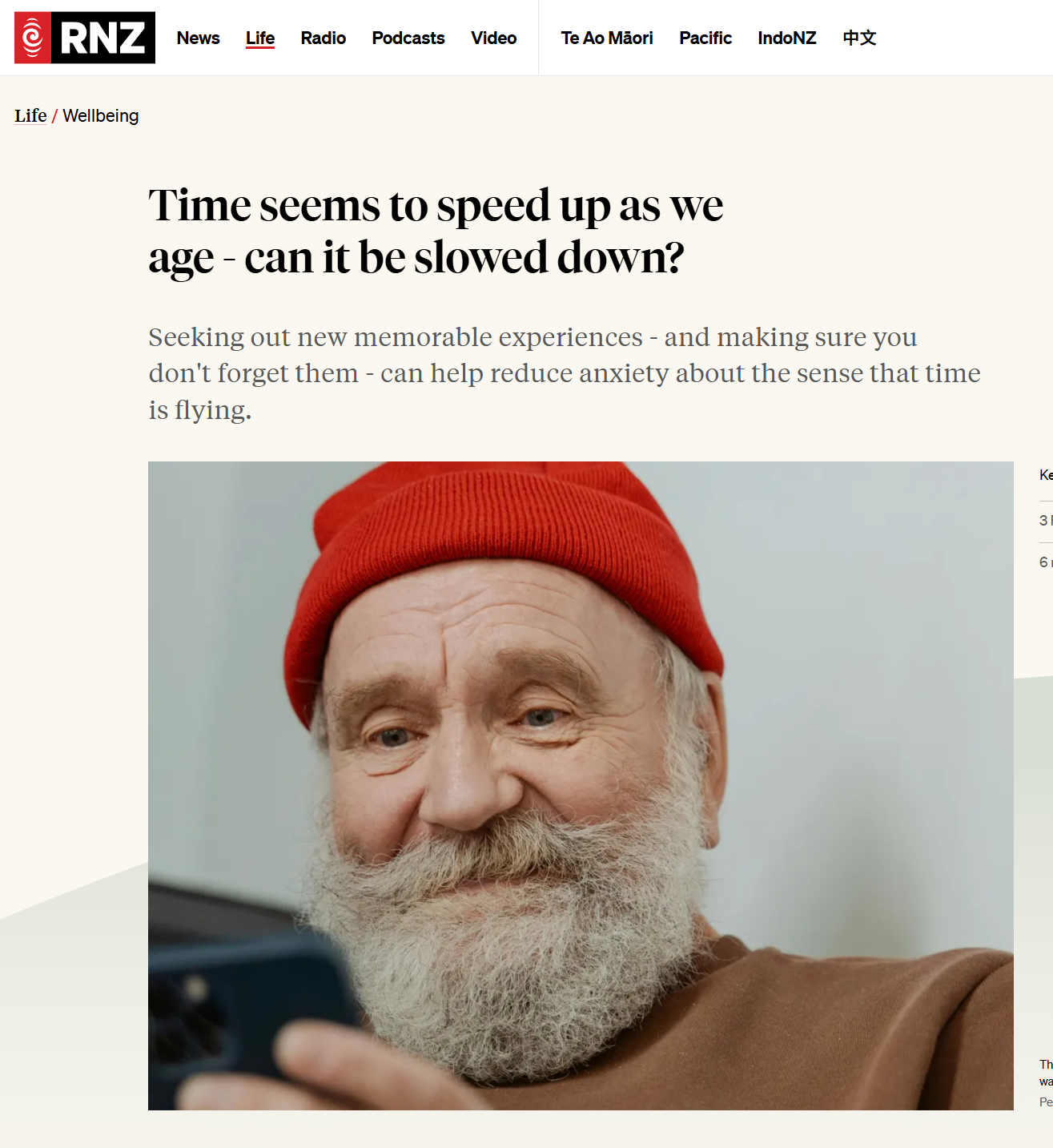
Time seems to speed up as we age - can it be slowed down?

From RNZ: When you're a kid, the wait between Christmases or birthdays feels like an eternity. Fast forward a few decades, though, and it seems like barely any time has passed between one year to the next.

The feeling that time speeds up as we age is a thing, says Hinze Hogendoorn, a professor in visual time perception at the Queensland University of Technology.

"When you're young, everything is new and exciting. First day of school, first car, first relationship, first job. There are lots of memorable firsts."

When you're young, before routine sets in, there are a lot of "memorable firsts", says Professor Hinze Hogendoorn.


Read more
READ MORE
2 Feb

NZ Post cuts services, raising fears for offline older Kiwis – The Front Page

NZ Post is removing services from 142 partner stores this year.

It follows a long line of postal groups around the world scaling back as we enter a new era dominated by tech.

Czech Post closed 300 post office branches, the Greek postal service shut more than 200 last year, UK networks have gone through rolling waves of reductions, and Denmark has ended traditional letter delivery entirely – an end to a 400-year-old service.

Of the 142 stores closing, 29 are in Auckland and 22 are in Christchurch.

“The remaining network of 567 stores will still be significantly larger than any New Zealand supermarket or bank branch network,” NZ Post general manager consumer Sarah Sandoval said.


Read more
READ MORE
14 Jan

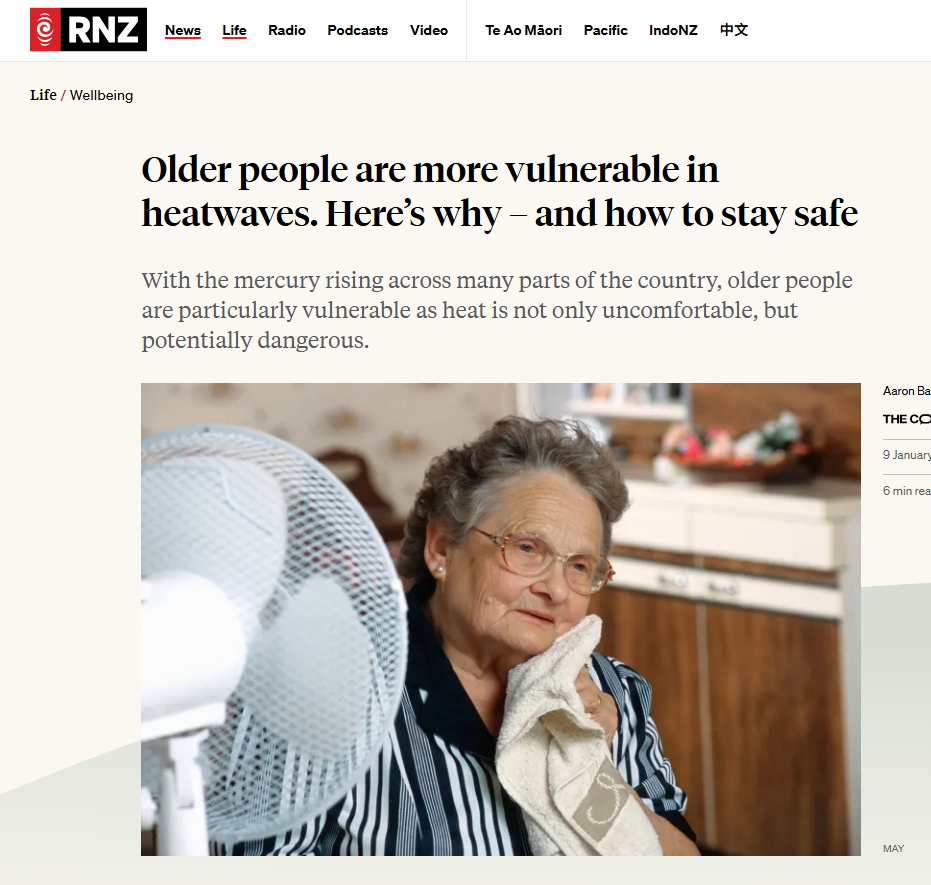
Older people are more vulnerable in heatwaves. Here’s why – and how to stay safe

With the mercury rising across many parts of the country, older people are particularly vulnerable as heat is not only uncomfortable, but potentially dangerous.


For vulnerable people, particularly the elderly, heat is not only uncomfortable but dangerous. High temperatures can worsen existing health problems and in some cases even prove fatal.

So as the mercury climbs, it’s important to understand why some people are more at risk.


Read more
READ MORE
8 Jan

Are New Zealanders getting lonelier?

From the Spinoff: The ‘loneliness epidemic’ is apparently spreading around the world, but what does it look like here in New Zealand? Rachel Judkins reports.

Summer read – originally published February 12 2025.

It’s a beautiful summer evening in Cornwall Park, with families scattered on the grass and a live band playing a backing track to their laughter. Sprawled on a picnic blanket with her young son, 46-year-old Florence* is trying to soak up the good vibes, but she can’t help feeling a heaviness. She loves doing these fun activities with her boy, but raising him alone is hard work and she craves adult company and longs to be part of a family unit again. Despite being surrounded by people, Florence is feeling lonely. 

Ironically, she isn’t alone in her loneliness. 

In 2023, a survey by global analytics firm Gallup revealed that 1 in 5 people worldwide said they felt lonely “a lot” during the previous day. In this study, Aotearoa was doing better than our allies Canada, US and the UK; on par with our neighbours Australia; but feeling lonelier than countries like Japan, Finland and Kazakhstan. But no matter where you go on this planet, loneliness is an issue.


Read more
READ MORE
8 Jan

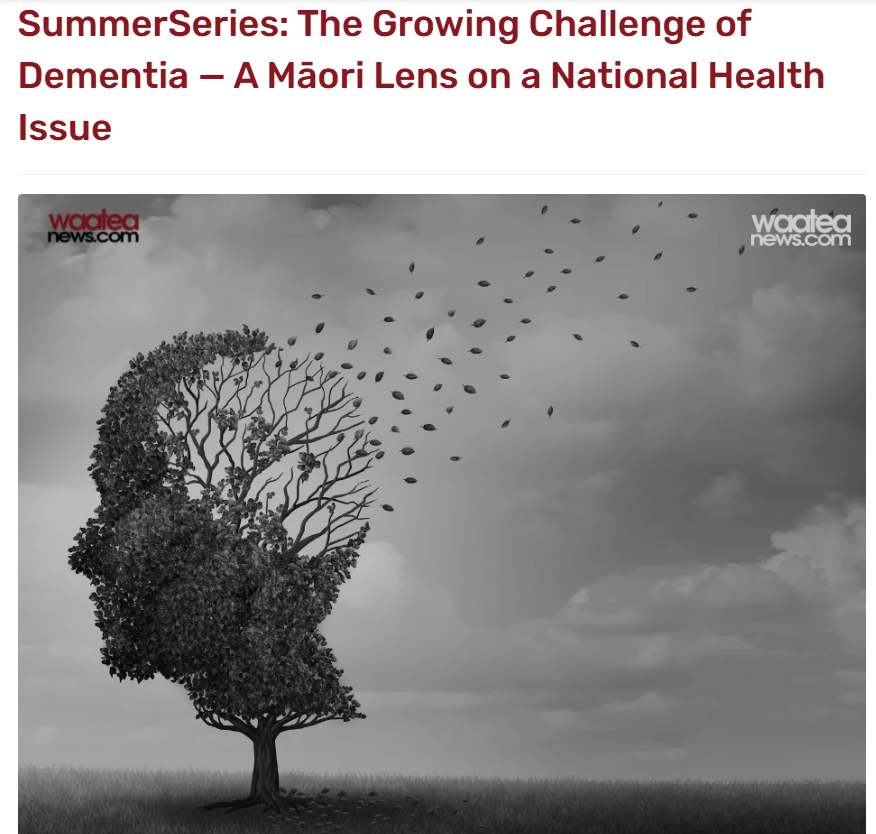
SummerSeries: The Growing Challenge of Dementia — A Māori Lens on a National Health Issue

This from Waatea News.com: 

Dementia is no longer a distant concern for future generations – it is here, growing, and already affecting whānau across Aotearoa. Known in te reo Māori as mate wareware, this condition involves progressive decline in memory and cognition. It affects not just the person living with it, but their whanau, community, and cultural wellbeing.

In New Zealand, recent research shows that dementia is under-recognised, with up to half of those who live with memory problems unaware they have the condition.


Read more
READ MORE
17 Dec '25

Transport subsidies for elderly and disabled people reduced

The government is cutting transport subsidies for elderly and disabled people for elderly and disabled people from 75 percent to 65 percent.

The Total Mobility scheme provides discounted taxis and public transport fares for those with long-term impairments.

Transport Minister Chris Bishop and Disability Minister Louise Upston said when the previous Labour government boosted the scheme from a 50 percent subsidy in 2022, it did not account for increased demand.

The number of registered users had increased from 108,000 to 120,000 between 2022 and 2024/25, and the number of trips increased from 1.8 million in 2018 to 3 million in 2024/25.

Bishop said the increased demand now meant the scheme was close to exceeding the funding provided by $236m sometime over the five years to 2030.

"The subsidy is split between the government and public transport authorities - local councils and the NZ Transport Agency (NZTA) - and provides an important service for the people who use the scheme," he said.


Read more
READ MORE
10 Dec '25

No, pensioners aren't getting a Christmas bonus

Superannuitants are being warned not to fall for a scam that claims they're in for a pre-Christmas bonus.

A hoax circulating online claims that people who are on NZ Super are to receive a "one-off December bonus" a few weeks before Christmas.

The payment is alleged to be $350 for single people and $560 for couples, as well as an extra $50 for people in Auckland, Wellington and Christchurch and $40 for people with disabilities.

The websites seem to be intended to funnel advertising and possibly collect identity details.

The Ministry of Social Development confirmed that the offer was not real.

"We are aware of fake information being targeted at MSD clients and older people about December bonuses, benefit increases, or changes to NZ Super," group general manager of client service delivery Graham Allpress said.

"We want to assure people these claims are not true. If you want up-to-date information on your benefit or NZ Super, check the Work and Income website or MyMSD.

"These posts and websites are created by dishonest actors for dishonest reasons, and are always best avoided."


Read more
READ MORE
9 Dec '25

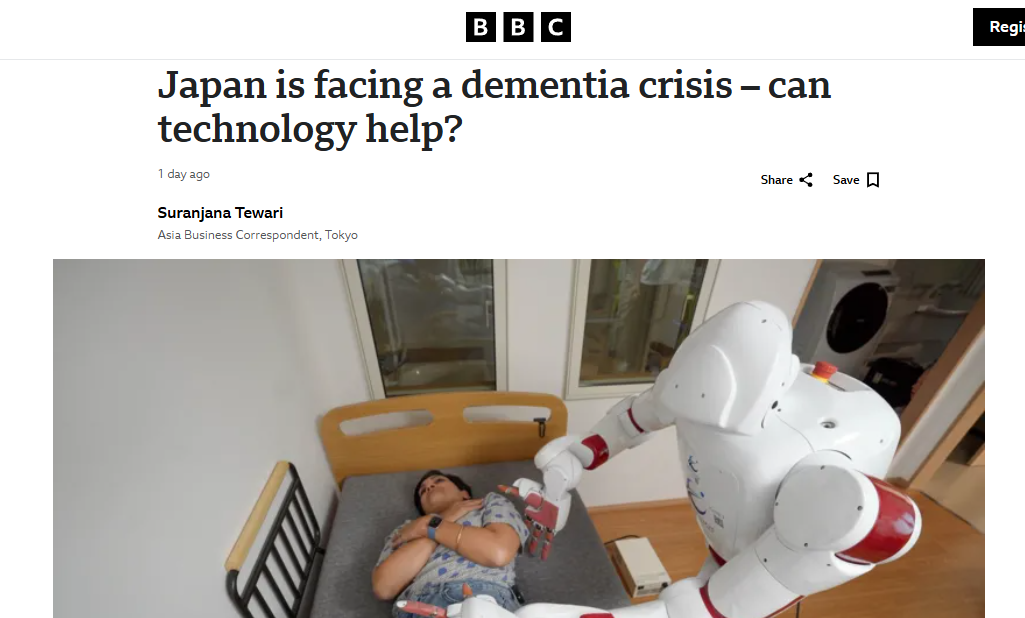
Japan is facing a dementia crisis – can technology help?

This from BBC news: 

Last year, more than 18,000 older people living with dementia left their homes and went missing in Japan. Almost 500 were later found dead.

Police say such cases have doubled since 2012.

Elderly people aged 65 and over now make up nearly 30% of Japan's population - the second-highest proportion in the world after Monaco, according to the World Bank.

The crisis is further compounded by a shrinking workforce and tight limits on foreign workers coming in to provide care.

Japan's government has identified dementia as one of its most urgent policy challenges, with the Health Ministry estimating that dementia-related health and social care costs will reach 14 trillion yen ($90bn; £67bn) by 2030 - up from nine trillion yen in 2025.

In its most recent strategy, the government has signalled a stronger pivot toward technology to ease the pressure.


Read more
READ MORE
5 Dec '25

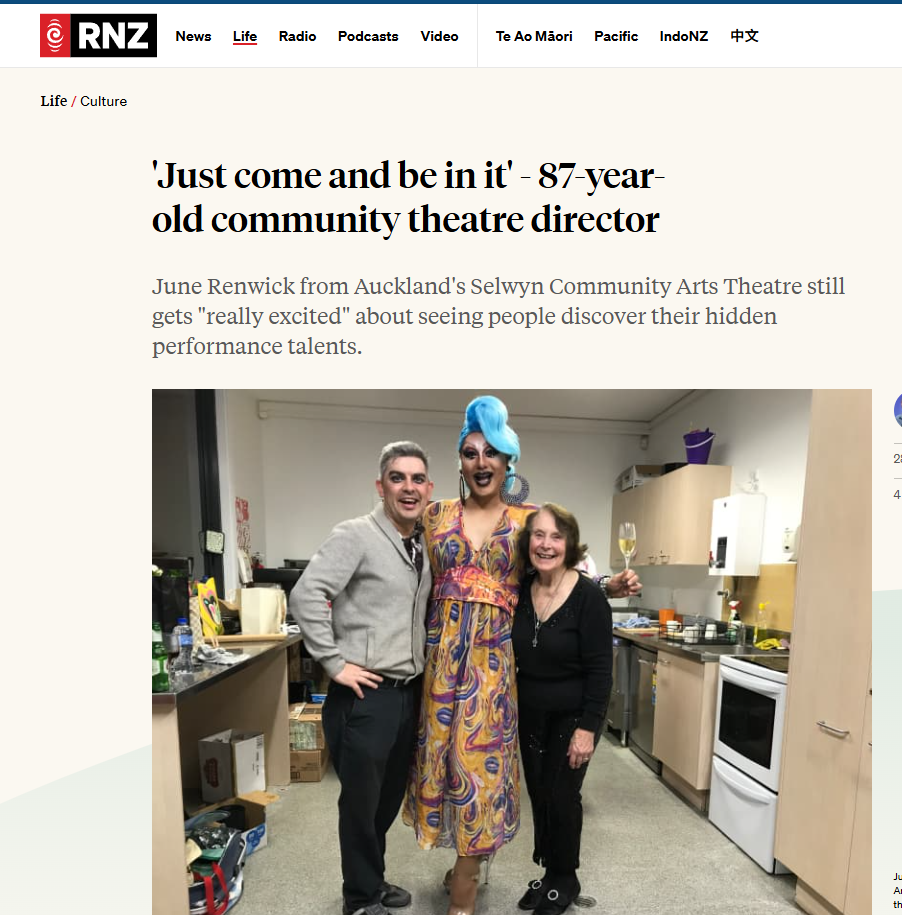
'Just come and be in it' - 87-year-old community theatre director

June Renwick from Auckland's Selwyn Community Arts Theatre still gets "really excited" about seeing people discover their hidden performance talents.

Culture 10128 September 20254 min readCaption:June Renwick (left) with cast members of Selwyn Community Arts Theatre's 2024 production of Priscilla: Queen of the Desert.Photo credit:Supplied

When she retired from teaching at Auckland's Selwyn College, June Renwick was determined to "get a community theatre happening". Now she directs and produces shows at the Selwyn Community Arts Theatre (SCAT).

Not only is community theatre a lot of fun, it also encourages diverse connections, Renwick says, not just in nationality, but in age.

"People make lasting friendships, like we're all going for a curry night soon up to Orewa", she tells Culture 101.


Read more
READ MORE
5 Dec '25

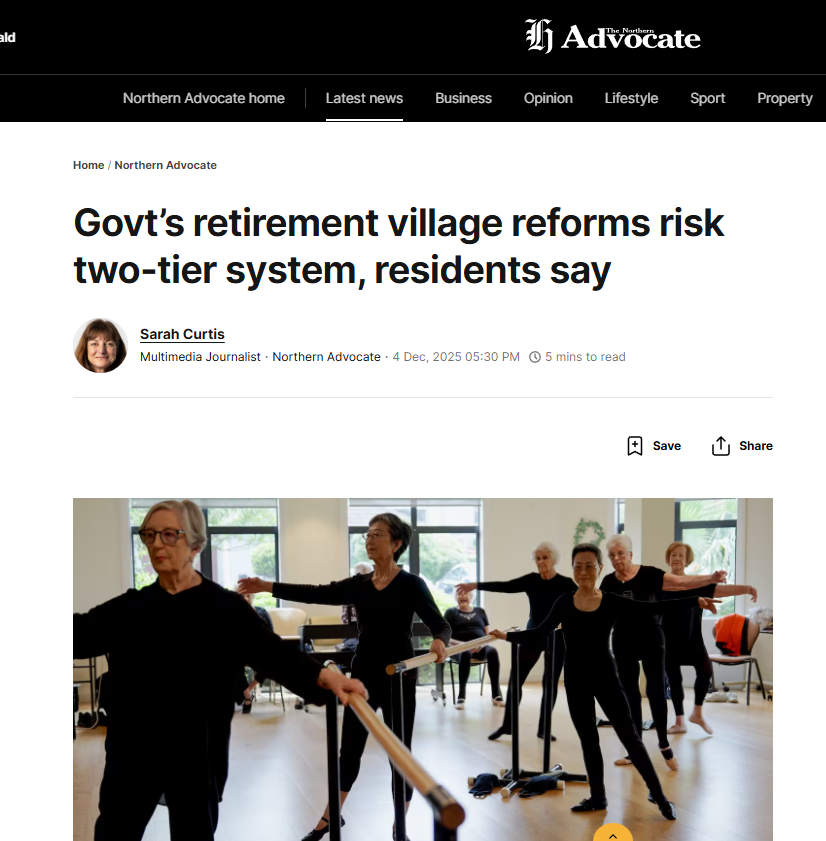
Govt’s retirement village reforms risk two-tier system, residents say

The Government’s promise of fairer rules for retirement villages could backfire if reforms only apply to future contracts and not to those who’ve fought so hard to secure them, residents warn.

Their comments follow today’s announcement by Associate Housing Minister Tama Potaka and Seniors Minister Casey Costello regarding the Retirement Villages Act reform.

Key improvements included a process for former residents to apply for early access to funds in situations of specific need; interest must be paid after six months if a unit remains unlicensed or unsold; repayment of funds no later than 12 months after a unit is vacated, and weekly fees and deductions stopping immediately when a resident vacates.

A Northland retirement village resident said after a long career in community advocacy, the last thing she expected when moving into her unit about five years ago was more battling.

But issues in her village – especially an ongoing wait for a promised specialist care facility – changed that.


Read more
READ MORE
3 Dec '25

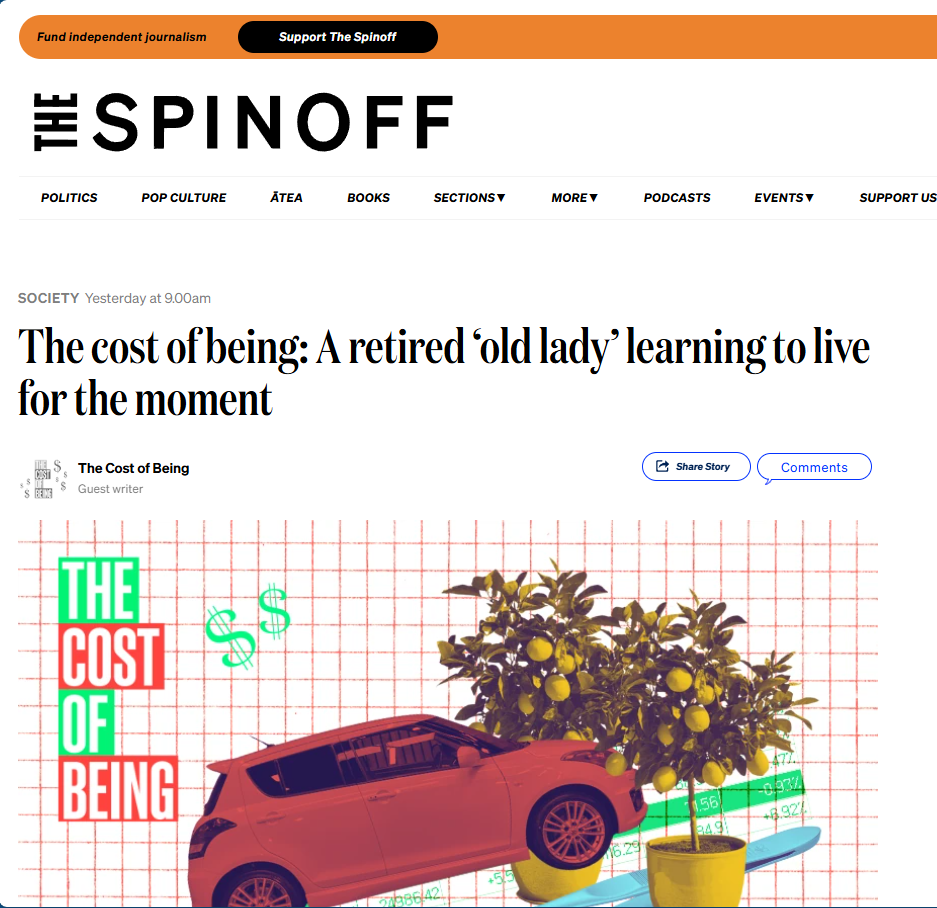
The cost of being: A retired ‘old lady’ learning to live for the moment

As part of our series exploring how New Zealanders live and our relationship with money, a pensioner with a lifetime of ‘squirrel habits’ explains where they spend and how they save.

Want to be part of The Cost of Being? Fill out the questionnaire here.

Gender: Old lady.

Age: 67.

Ethnicity: Pākehā.

Role: Retired, domestic husband wrangler.

Salary/income/assets: Pension, small investment return.


My living location is: Suburban.

Rent/mortgage per week: Mortgage repaid a few years ago.

Student loan or other debt payments per week: None.


Read more
READ MORE
28 Nov '25

10-year-old business owner goes viral for free lawn mowing services to kaumātua

From Te Ao Maori News: 

A 10 year-old living in Raahui Pookeka that has gone viral for giving free lawn mowing services to kaumaatua in Huntly.

Harry Muru-Kete is the business owner of his lawn mowing service called, “Second 2 None”.

In an Instagram post, hundreds of people praised Muru-Kete for his free service to kaumātua within his community. Muru-Kete said within the next 24-hours his social media following skyrocketed, all for kaumaatua who are the most valued treasure in their community.


Read more
READ MORE
27 Nov '25

Scientists discover four major turning points for human brain

From RNZ: The five brain phases were split into: childhood brain, adolescent brain, adult brain, early ageing brain and late ageing brain. 

Scientists have discovered the human brain goes through five different phases of life, with key turning points at four different ages.

These "major turning points" occur around the ages of 9, 32, 66 and 83, a media release from the University of Cambridge said.

The neuroscientists from Cambridge University found the brain structure changes over the course of a human life, as the brain rewires to "support different ways of thinking while we grow, mature, and ultimately decline".

The study that was led by the university's MRC Cognition and Brain Sciences Unit compared brains of more than 3800 people aged between 0 and 90.

According to scientist and research lead Dr Alexa Mousley, it is the first study to "identify major phases of brain wiring across a human lifespan".


Read more
READ MORE
25 Nov '25

ANZ warns of social media investment scams using its branding, and targeting older Kiwis

ANZ is warning New Zealanders to remain on high alert after a new wave of investment scams emerged, targeting users on social media with fake ads that misuse the bank's branding.

The latest scam, identified this week, involves an advertisement promoting a stock market education programme featuring the ANZ's logo. The ad directed people to join group chats for investment advice — a tactic ANZ says is designed to pressure individuals into fraudulent schemes.

"The ads are the latest in a long line of investment scams. Sadly, they won’t be the last," said Alan Thomsen, Head of Customer Protection at ANZ.

ANZ has reported the ads to the platform and is monitoring for similar content alongside the financial markets authority. The bank emphasised it does not offer stock trading education programmes and that official posts would only come from its verified account.


Read more
READ MORE
24 Nov '25

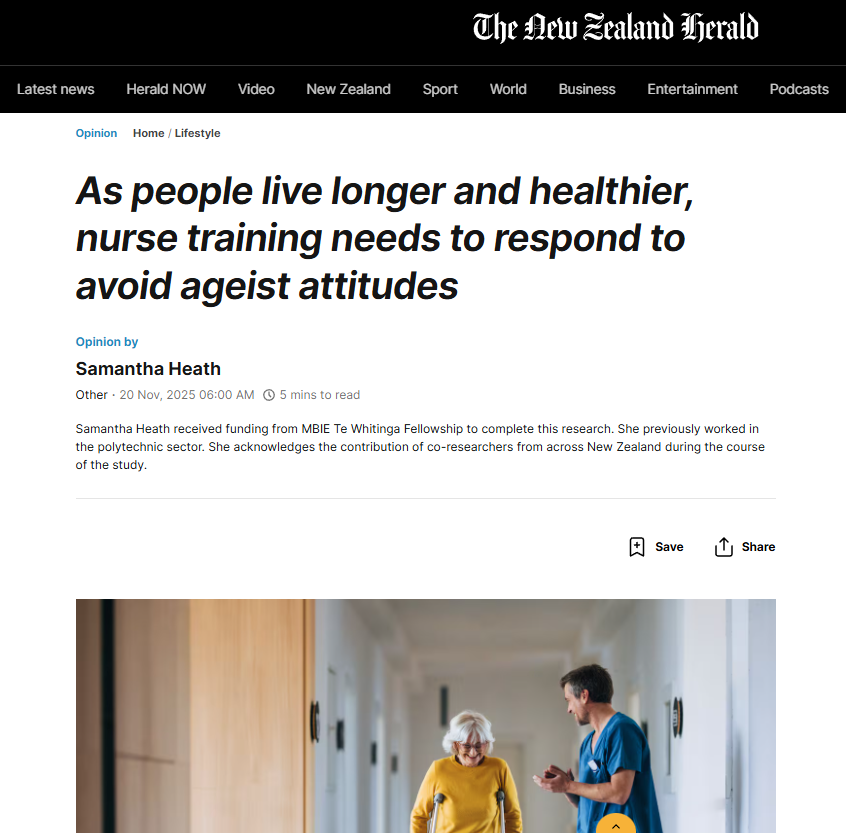
As people live longer and healthier, nurse training needs to respond to avoid ageist attitudes

From the Hearald: Opinion by Samantha Heath
THE FACTS

  • Life expectancy has significantly increased, leading to more years with chronic conditions and disabilities.
  • Ageism in healthcare results in missed diagnoses and under-treatment of older adults.


Life expectancy in New Zealand has increased dramatically over the past five decades. In 1970, men lived on average to 68. Today, it’s over 80.

These gains reflect major advances in public health and medical technology. But living longer can mean more years with multiple chronic conditions and disabilities, because age is a significant risk factor for most disease.

This demographic shift will reshape healthcare. Future health professionals will need to be aware of the increasingly complex social, technological and ethical challenges of caring for older people.


Read more
READ MORE
17 Nov '25

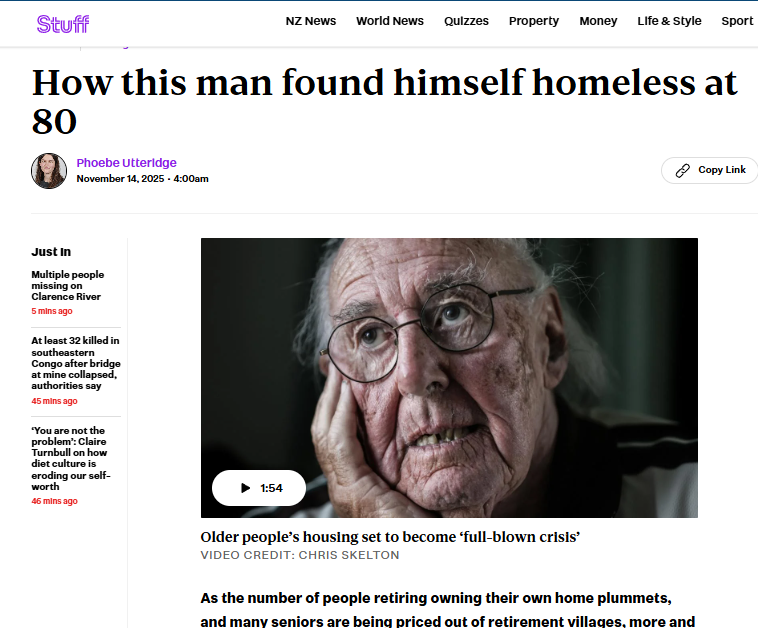
How this man found himself homeless at 80

Stuff reports: As the number of people retiring owning their own home plummets, and many seniors are being priced out of retirement villages, more and more people over 65 are being left with nowhere to live. Phoebe Utteridge reports.

When Nick Carswell found out his rural Canterbury rental was going to be deemed unfit for tenancy in 2023, it was “a moment of sheer horror”.

“I thought I had nowhere to go,” he said.

The then-80-year-old had lived in a cottage on Miners Rd in Yaldhurst for 16 years. . Conditions in the house deteriorated impacting his health to the point he ended up in hospital.

His family attempted to restore the property so Carswell could continue to live in the countryside, but the property was declared unfit for tenancy.


Read more

READ MORE
17 Nov '25

Age Concern Whanganui seeks donations to Secret Santa gift initiative

Age Concern Whanganui is on a mission to give older people gifts this Christmas.

It is the seventh year the organisation has run its Secret Santa programme which aims to ease the loneliness of older Whanganui residents over the holidays.

Age Concern is asking for gift items or monetary donations to be dropped off at its office at 164 St Hill St – or a volunteer can arrange to collect donations if they are unable to be dropped off – until December 4.

“We were aware that the Christmas time can be very hard for older people in our community and so we collect gifts,” Age Concern Whanganui manager Michelle Malcolm said.


Read more

READ MORE
7 Nov '25

Beneficiaries, pensioners don't have enough money for basics - report

In news from RNZ: Households living on JobSeeker Support or NZ Super alone have to spend more each week than they have coming in to cover the basics, on average, a new report says.

Kore Hiakai, the Zero Hunger Collective, has issued its latest annual report - Ka Makona - which notes 27 percent of children are living in food-insecure households.

This year, older people have been added to the household scenarios, modelling weekly income and basic housing, food, transport and utilities expenses for an older person living alone and an older couple.

Single adults, sole parents with two children and two-parent households with two children were also considered.

Housing costs are based on rents for a single adult living in a shared flat, an older person in a one-room unit and an older couple in a two-bedroom house. Family households are based on three-bedroom rentals.


Read more
READ MORE
6 Nov '25

NZ’s Fastest Growing Opportunity: New Pledges Show Ways To Boost The Wellbeing, Productivity And Resilience

Five priorities for investment in longer, better, more sustainable lives
Urgent cross-sector action to support older New Zealanders to live longer, healthier and more connected lives has been called for by the Aotearoa New Zealand National Forum for the Decade of Healthy Ageing He Oranga Kaumātua, He Oranga Tangata at Parliament this morning.

Policy and decision-makers are being urged to back five transformative, yet cost-effective pledges that will support a New Zealand where everyone can thrive and age well in communities, thereby lifting wellbeing, boosting productivity and building national resilience.

The pledges are evidence-based, drawing on research by the New Zealand Institute of Economic Research (NZIER), and offer practical solutions to significant issues that are currently undermining the potential and long term opportunities arising from an ageing population: ageism, unsuitable and unaffordable housing, a lack of “whole-of-life” planning, loneliness and social isolation, and poor health outcomes.


Read more
READ MORE
29 Oct '25

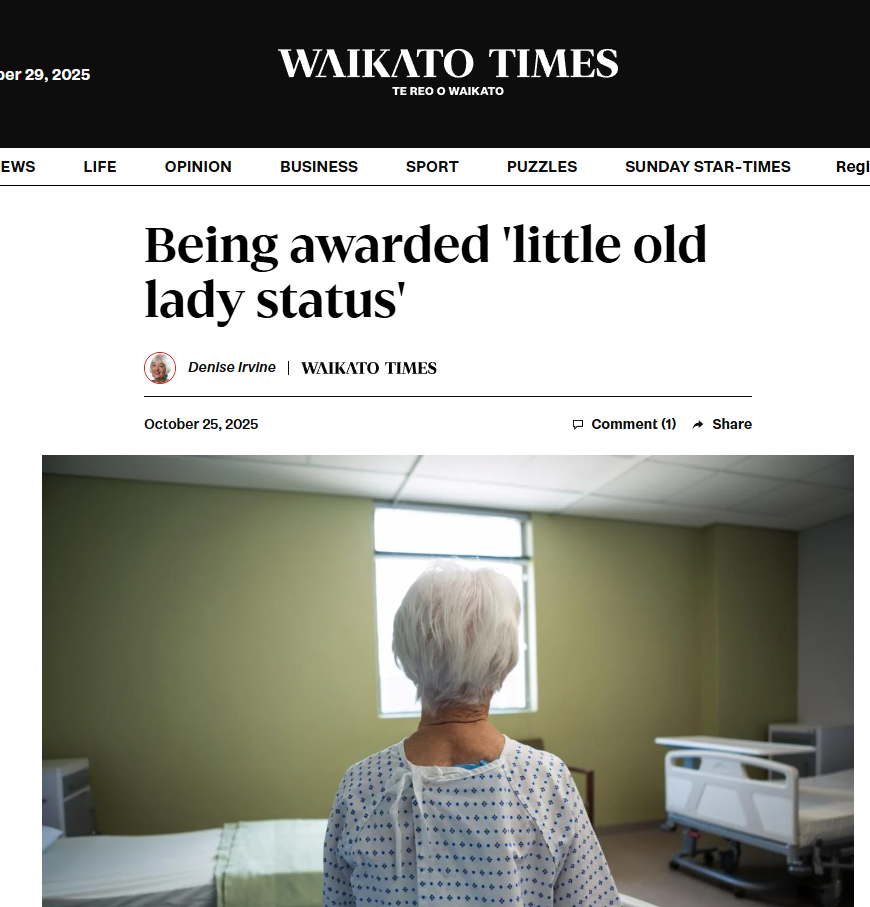
Being awarded 'little old lady status'

Waikato times piece: 

Denise Irvine is a Hamilton freelance journalist and food writer, and a regular Waikato Times contributor.

OPINION: I had a medical appointment recently with a nurse who used relentlessly first-person plural pronouns as she stepped me through a list of questions:

“Do we know our height? What is our date of birth? Are we on any medications? Do we have any existing medical conditions? Who is our next of kin? I’ll just check our weight, can we please pop onto the scales.” And so on.


Read more
READ MORE
29 Oct '25

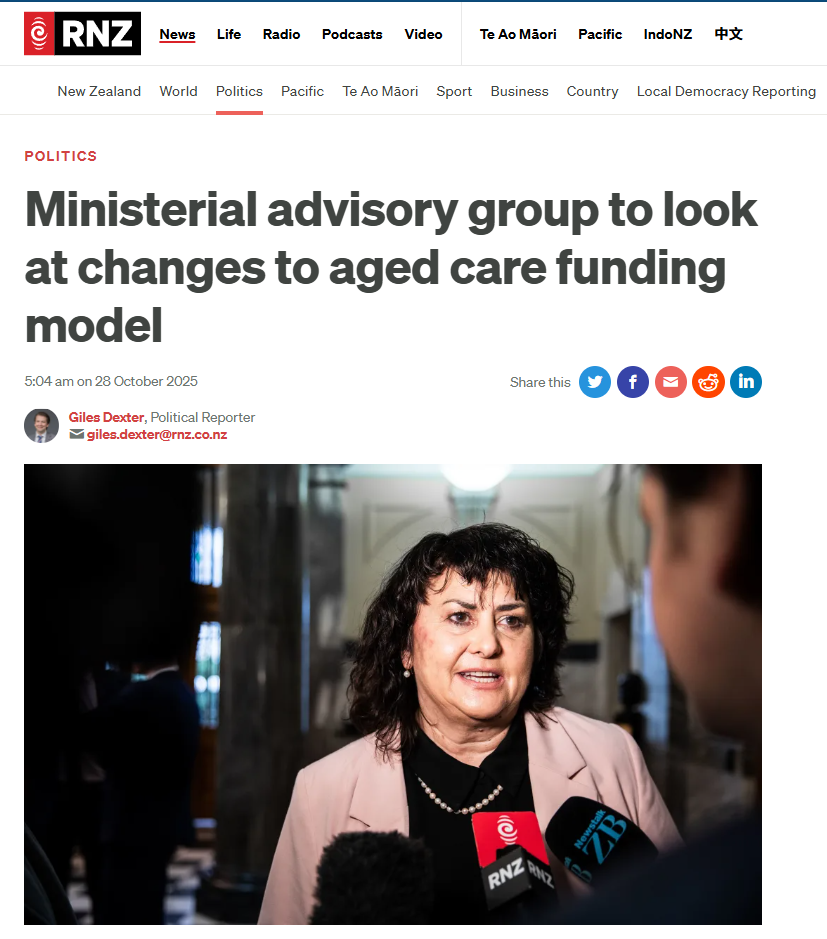
Ministerial advisory group to look at changes to aged care funding model

This from RNZ: Changes to the aged care funding model are on the cards, with a ministerial advisory group being established to make recommendations to a system the government says is out of date.

The government currently spends $2.5 billion a year on aged care, which is provided privately.

Associate Health Minister Casey Costello said there were "major political considerations" attached to any changes, and so an independent group was needed to make recommendations, as well as long-term thinking and a bipartisan approach.

She said the announcement was about better health outcomes for the 900,000 New Zealanders who were over 65, and a better, fit-for-purpose aged care system.

The number of New Zealanders aged 65 or older is expected to increase to 1.3 million by 2040.

"We know that New Zealand has very good aged care, provided by dedicated people. However, the way that these services are funded is outdated and does not recognise the connection between the various parts of the system or the future investment required," said Costello, who is also Minister for Seniors.

"Essentially, our aged care model is out of date and piecemeal change isn't the solution."


Read more
READ MORE
23 Oct '25

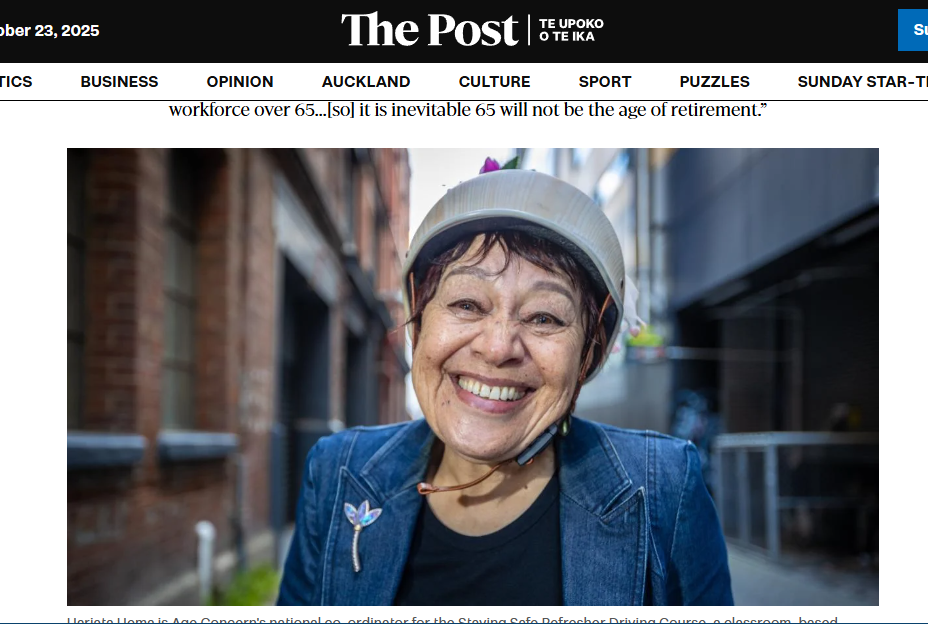
Still on the clock: No stepping off the treadmill for the over 65s

Read The Post: 

Turning 65 used to mean both a gold watch and a portal to the euphemistically-monikered “golden years” of a comfortable retirement.

Yet as life expectancy grows and living costs soar the idea of stepping off the working treadmill in your mid 60s has become increasingly unrealistic for many.

At 24% we have one of the highest rates of people aged over 65 who are still working, compared with other countries such as Australia (12%) and the UK (10%).

According to StatsNZ there are almost 200,000 working New Zealanders aged 65 or older. Almost 90,000 are aged over 70.

Certainly there’s any number of politicians, chief executives and property developers still on the tools into their 60s and 70s - and 2023 census data shows 42,000 people earning over $100,000 while collecting superannuation.


Read more
READ MORE
23 Oct '25

Age Concern New Zealand Supports New Report On Age-Proofing Aotearoa

This from Scoop: 

Age Concern New Zealand welcomes the findings and recommendations in the latest report from WSP and The Helen Clark Foundation, titled Age-proofing Aotearoa: Rethinking our infrastructure for an ageing population.

“We are pleased to see so many of our own priority areas addressed in this report, backed by robust data analysis. As a charity with a proud heritage leading, advocating, connecting, and collaborating to see the delivery of local services, we do not have the resources to develop such an in-depth data analysis ourselves. We see this as an extremely valuable contribution for decision-makers,” says Karen Billings-Jensen, Chief Executive, Age Concern New Zealand.

At today’s report release at Parliament, Kali Mercier, WSP Fellow and Deputy Director of the Helen Clark Foundation, asked guests to consider their age in 2048, when some regions will be experiencing ‘hyper-ageing’, with 30% of residents expected to be aged 65. “It was a valuable reflection of the future, with some decision-makers present aged over 65 around that time. Their decisions now will be personal for them in 23 years” says Mrs Billings-Jensen.


Read more
READ MORE
21 Oct '25

Who said women over 50 had to be invisible?

I’ve long felt uncomfortable with the idea that women become invisible with age; that now I’m in my 50s, I should be prepared to fade from view. Is that really how it is?

When I asked other women in my Gen X cohort about their experiences, they shared more than one tale of apparent physical invisibility with me: “I had my first experience of invisibility last week – I was standing at a counter ready to purchase, and two other people (who were standing behind me) got served first”, said one woman. Another shared something similar, adding “It surprised me as I am tall and very hard to overlook!”

Some women have experienced it showing up in working life: “I’m definitely feeling invisible in the job market at the moment,” one woman told me. “I have applied for over 30 jobs in the last three months, and not a nibble back. I’m not sure if it’s just the job market, gender, age, seniority…. or all of the above.”


Read more
READ MORE
21 Oct '25

Innovative Māori aged care model set to bring aroha, manaakitanga to kaumātua

Aged care in Aotearoa New Zealand is in crisis. Reports of staff being underpaid and over worked are common as are the reports of elderly residents not getting the care they should. Kaitiaki is exploring what’s happening in this space. We talk with a granddaughter who is on a mission to transform aged care for Māori, starting with kaumātua from her own tribe.


Read more
READ MORE
21 Oct '25

Air New Zealand pilot wins age discrimination case

A pilot who claimed Air New Zealand discriminated against him because of his age has succeeded in a personal grievance claim against the airline.

Captain Garth McGearty took the claim against Air New Zealand to the Employment Court, after he was turned down by the Employment Relations Authority, alleging unjustified disadvantage and unlawful discrimination because of age.

The NZ Airline Pilots Association (NZALPA) was also involved because the issues for determination involved interpretation of the union's collective agreement.

McGearty had reached the most senior rank, as captain of the Boeing 777.

He turned 65 in July 2017.


Read more
READ MORE
15 Oct '25

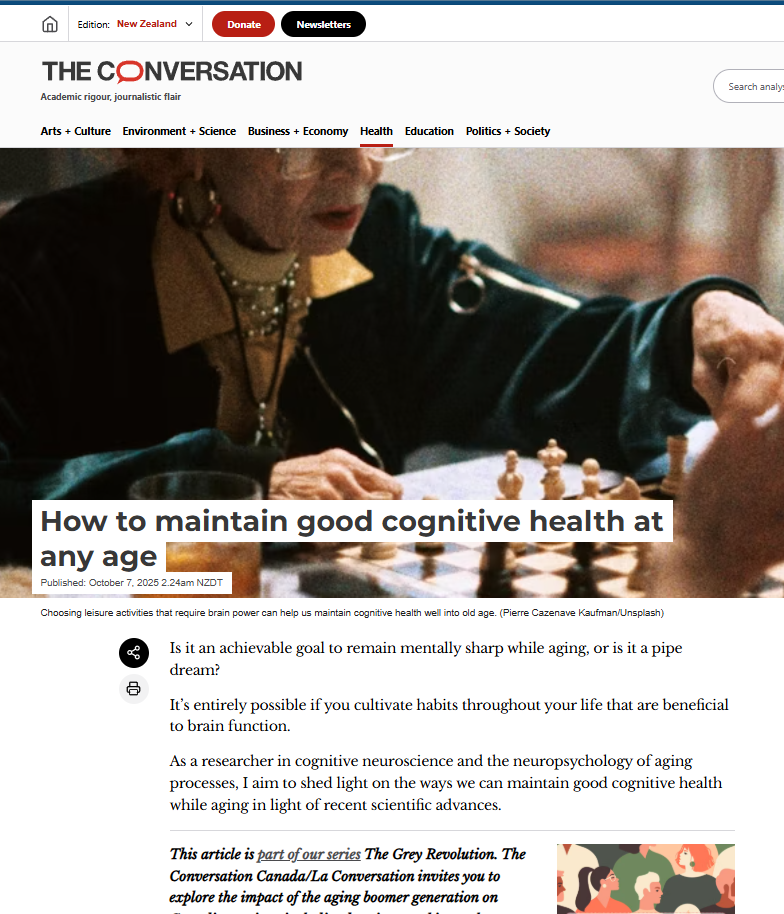
How to maintain good cognitive health at any age

Is it an achievable goal to remain mentally sharp while aging, or is it a pipe dream?

It’s entirely possible if you cultivate habits throughout your life that are beneficial to brain function.

As a researcher in cognitive neuroscience and the neuropsychology of aging processes, I aim to shed light on the ways we can maintain good cognitive health while aging in light of recent scientific advances.


Read more
READ MORE
10 Oct '25

What's Your Self-Talk About Aging?

A few years ago, as a travel journalist in Asia, I had an appointment with a spiritual leader in his office, and I was told that he was 94 years old.

I arrived at his office door, rang the bell, and a vigorous man with a booming voice answered and beckoned me to come in. The first thing he said was, “There will be no mention of age during our meeting. You will not use words like ‘older’ or ‘90s’ or ask me any questions that in any way refer to the amount of time I have been alive. Now let’s begin. I am a very busy man because I run six different companies.”

I was surprised, of course, but during our interview, I understood where he was coming from. He referred several times to his belief that accepting labels and holding stereotypical views about what happens when we have spent many years on planet earth can be limiting, self-defeating, and depressing.

Recently, in Santa 


Read more
READ MORE
6 Oct '25

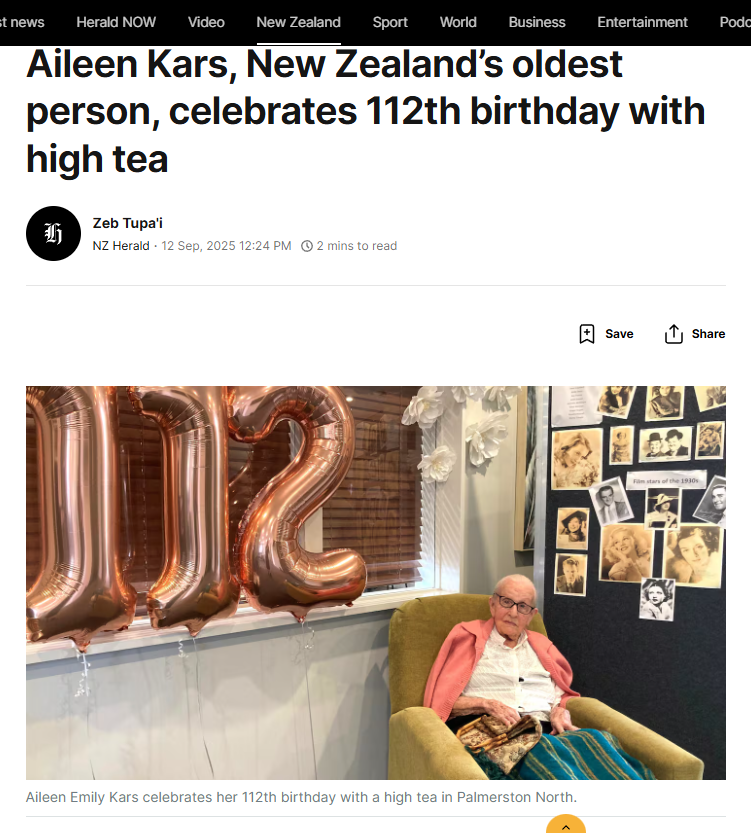
Aileen Kars, New Zealand’s oldest person, celebrates 112th birthday with high tea

Coffee fudge, walnut slice and pikelets were just some of the delectable delights served at a high tea honouring our oldest Kiwi.

Aileen Emily Kars turns 112 today and is celebrating the milestone at her rest home in Palmerston North with dancing and singing to the guitar.

Born in nearby Tokomaru on September 12, 1913, she is New Zealand’s oldest living person.

There are only 50 people older than her worldwide, according to the US Gerontology Research Group.


Read more
READ MORE
1 Oct '25

Age Concern New Zealand Huia Award 2025, Celebrating Outstanding Contributions

Age Concern New Zealand is pleased to announce the recipients of the Age Concern New Zealand Huia Awards 2025, honouring three extraordinary individuals whose dedication has uplifted the wellbeing, dignity, and visibility of older people across Aotearoa.

“These awards shine a light on the remarkable individuals who are driving change and helping make Aotearoa New Zealand a better place to grow older. It’s a meaningful occasion for Age Concern New Zealand and forms part of our recognition of the International Day of Older Persons, promoting respect, inclusion, and the value of our older generations,” says Karen Billings-Jensen, Chief Executive of Age Concern New Zealand.


Read more
READ MORE
1 Oct '25

Super-spry seniors help launch book on ageing better

The Devonport Flagstaff reports: Inspirational… author Leigh Elder (82) with former national tennis champ Margaret Borland (99) and former top running coach Arch Jelley (103)

Eighty-two-year-old Devonport resident Leigh Elder is an exemplar of active living, but says he is “only a kid” compared with some of the inspiring seniors at his book launch.
Among them was Arch Jelley, 103, master running coach to Olympic gold medallists Peter Snell and John Walker. The story of the Auckland “super ager” who still walks kilometres a day is one of several Elder tells in his latest book Don’t Act Your Age – Living younger can be age defying.
Another who attended was former national tennis champion Margaret Borland, aged 99, who came from Dunedin for the launch held at the William Sanders Retirement Village last Friday.


Read more
READ MORE
1 Oct '25

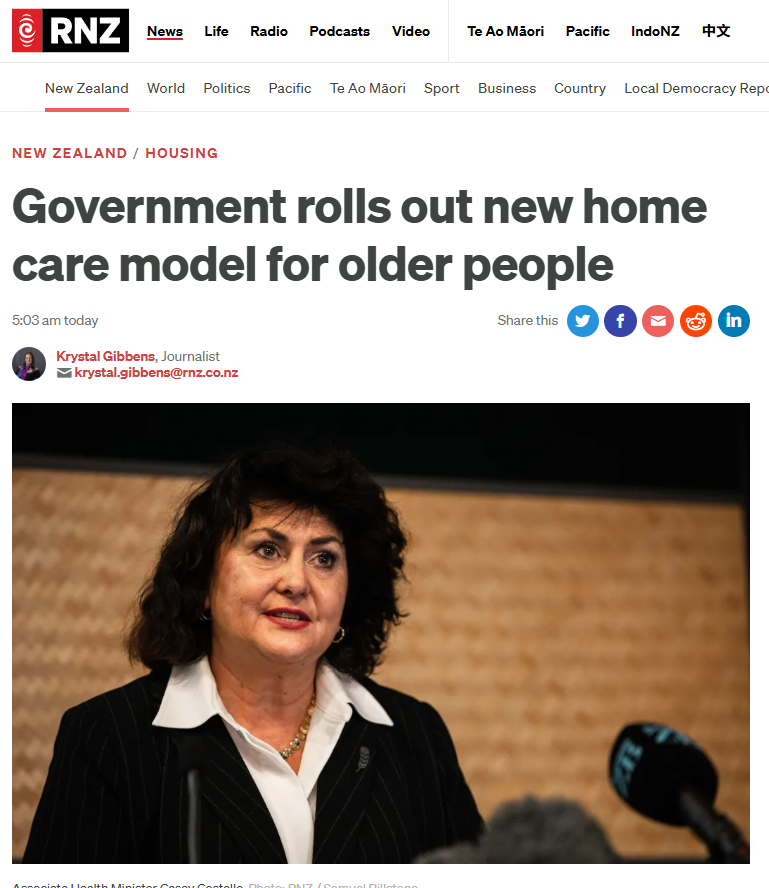
Government rolls out new home care model for older people

This from RNZ: The government will begin rolling out a more flexible new system for delivering home care services to older people in the South Island on Wednesday.

Associate Health Minister Casey Costello said it was one of a series of improvements being made to the current aged care system, backed by a significant increase in funding.

The aged residential care sector has received a 4 percent funding uplift and would see a total increase of $96 million this year, while funding for home and community support services would increase by $44m.


Read more
READ MORE
29 Sep '25

Aucklanders urged to get emergency ready this daylight saving weekend

From Our Auckland: 

Emergencies don’t RSVP; they show up uninvited. Investing a little time in emergency preparedness now can make a big difference in keeping you safer and less stressed when an emergency happens.

So this spring, Auckland Council and its Auckland Emergency Management department have launched a compelling new public awareness campaign encouraging Aucklanders to use daylight saving weekend to get emergency ready.


Read more

Our Collaborators

Organisations we work with

Davis Funnerals logoWhau local boardDementia Auckland logoUniversity of AucklandKristin School logoMacular Degeneration New ZealandACC Stronger for LongerGlaucoma NZ logoTe Uru Tangata  - Workplace inclusion Kahui Tu Kaha

Charity Name: Age Concern Auckland Trust
Registration Number: CC60750

What we do - Services
    Say hello

    09-820-0184

    ageconcern@ageconak.org.nz

    57 Rosebank Road, Avondale, Auckland 1026

    Monday-Friday 9am-4pm

    SUBSCRIBE
       WE WONT SPAM YOU


    All Rights Reserved. © 2026 Age Concern Auckland