Stay up to date with the latest news affecting older people in Auckland and across Aotearoa.
At Age Concern Auckland, we curate relevant articles, updates, and stories on topics like elder wellbeing, healthcare, housing, community
services, and policy changes. Check back regularly for fresh content that matters to seniors, their whānau, and caregivers.
Hearing Care Must Be Focus Of ACC Reform Says Audiology Sector
From Scoop News: Reform of the audiology market must go beyond securing cheaper hearing devices and seek to improve equitable access to professional care and deliver better hearing health outcomes for New Zealanders, says the New Zealand Audiological Society (NZAS).
NZAS Executive Director Ken Trass says the ACC-commissioned Audiology Market Review provides a useful foundation for reform, but changes to device purchasing alone will not address the wider barriers people face in getting the ear and hearing care they need.
“Better purchasing and sustainable funding for hearing devices are important but proper reform must also address how professional ear and hearing care is funded and delivered.”
This from Athletics New Zealand:We are deeply saddened to share the passing of legendary coach and Life Member Arch
Jelley, who died on
the 24th of October, aged 104.
Arch’s coaching career spanned more than five decades and shaped generations of New Zealand middle-distance running. He is best known for
guiding Sir John Walker to a world mile record of 3:49.4 in 1975, the first sub-3:50 mile in history, and to the 1976 Olympic 1500m title in
Montreal.
Born in Dunedin on 13 August 1922, Arch joined the Mornington Harrier Club at 18. His running was put on hold by the Second World War, when
he served in the navy, including Russian Convoy duty aboard HMS Bermuda. He went on to a long career in education, spending more than 20
years as principal of Sunnybrae Normal School on Auckland’s North Shore.
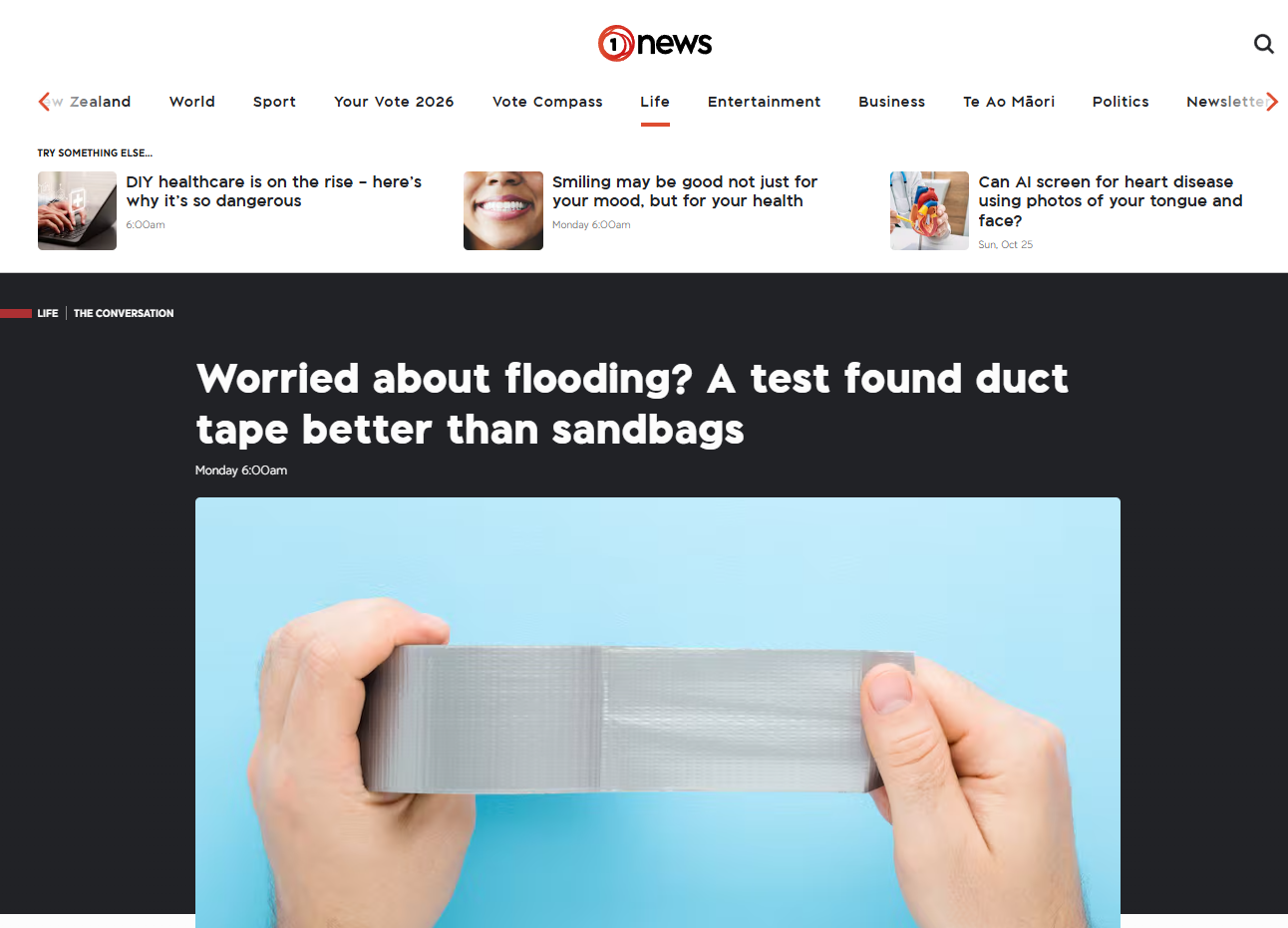
Worried about flooding? A test found duct tape better than sandbags
Shared by One News: Could a cheap roll of duct tape help protect your home from flooding? New research suggests it
could make a surprisingly big difference.
By Stuart McLelland for The Conversation
In controlled tests, correctly applied duct tape on the outside of a household door reduced water leakage by 97-98%. The findings suggest
that a simple low-cost measure could substantially reduce the amount of water entering a home during a flood. This is important as one of
the key lessons from flood resilience research is that the best time to protect a property is before floodwater arrives.
The UK government’s 2025 FloodReady Review called for practical, affordable measures that help households understand their risks and to
prepare for flooding. And one potential contribution to this agenda might sound unlikely, at first glance.
Duct tape is more commonly associated with household repairs than flood protection. However, tests colleagues and I conducted at the
University of Hull demonstrated how much water can enter a property through an unprotected doorway during a flood.
Inside our laboratory we tested modern wooden, uPVC and composite household doors, installed by trade professionals. We captured any water
that leaked through the door in a sealed enclosure behind the door, as we increased water depth in 5cm increments to a maximum depth of
60cm. We pumped out any water that leaked through the door and continuously measured the rate of water leakage to evaluate the performance
of doors and different types of protection applied to them.