
Make a Referral Make a Referral
Header Text

News

Stay up to date with the latest news affecting older people in Auckland and across Aotearoa.


At Age Concern Auckland, we curate relevant articles, updates, and stories on topics like elder wellbeing, healthcare, housing, community services, and policy changes. Check back regularly for fresh content that matters to seniors, their whānau, and caregivers.

READ MORE
Today

No, pensioners aren't getting a Christmas bonus

Superannuitants are being warned not to fall for a scam that claims they're in for a pre-Christmas bonus.

A hoax circulating online claims that people who are on NZ Super are to receive a "one-off December bonus" a few weeks before Christmas.

The payment is alleged to be $350 for single people and $560 for couples, as well as an extra $50 for people in Auckland, Wellington and Christchurch and $40 for people with disabilities.

The websites seem to be intended to funnel advertising and possibly collect identity details.

The Ministry of Social Development confirmed that the offer was not real.

"We are aware of fake information being targeted at MSD clients and older people about December bonuses, benefit increases, or changes to NZ Super," group general manager of client service delivery Graham Allpress said.

"We want to assure people these claims are not true. If you want up-to-date information on your benefit or NZ Super, check the Work and Income website or MyMSD.

"These posts and websites are created by dishonest actors for dishonest reasons, and are always best avoided."


Read more
READ MORE
Yesterday

Japan is facing a dementia crisis – can technology help?

This from BBC news: 

Last year, more than 18,000 older people living with dementia left their homes and went missing in Japan. Almost 500 were later found dead.

Police say such cases have doubled since 2012.

Elderly people aged 65 and over now make up nearly 30% of Japan's population - the second-highest proportion in the world after Monaco, according to the World Bank.

The crisis is further compounded by a shrinking workforce and tight limits on foreign workers coming in to provide care.

Japan's government has identified dementia as one of its most urgent policy challenges, with the Health Ministry estimating that dementia-related health and social care costs will reach 14 trillion yen ($90bn; £67bn) by 2030 - up from nine trillion yen in 2025.

In its most recent strategy, the government has signalled a stronger pivot toward technology to ease the pressure.


Read more
READ MORE
5 Dec

'Just come and be in it' - 87-year-old community theatre director

June Renwick from Auckland's Selwyn Community Arts Theatre still gets "really excited" about seeing people discover their hidden performance talents.

Culture 10128 September 20254 min readCaption:June Renwick (left) with cast members of Selwyn Community Arts Theatre's 2024 production of Priscilla: Queen of the Desert.Photo credit:Supplied

When she retired from teaching at Auckland's Selwyn College, June Renwick was determined to "get a community theatre happening". Now she directs and produces shows at the Selwyn Community Arts Theatre (SCAT).

Not only is community theatre a lot of fun, it also encourages diverse connections, Renwick says, not just in nationality, but in age.

"People make lasting friendships, like we're all going for a curry night soon up to Orewa", she tells Culture 101.


Read more
READ MORE
5 Dec

Govt’s retirement village reforms risk two-tier system, residents say

The Government’s promise of fairer rules for retirement villages could backfire if reforms only apply to future contracts and not to those who’ve fought so hard to secure them, residents warn.

Their comments follow today’s announcement by Associate Housing Minister Tama Potaka and Seniors Minister Casey Costello regarding the Retirement Villages Act reform.

Key improvements included a process for former residents to apply for early access to funds in situations of specific need; interest must be paid after six months if a unit remains unlicensed or unsold; repayment of funds no later than 12 months after a unit is vacated, and weekly fees and deductions stopping immediately when a resident vacates.

A Northland retirement village resident said after a long career in community advocacy, the last thing she expected when moving into her unit about five years ago was more battling.

But issues in her village – especially an ongoing wait for a promised specialist care facility – changed that.


Read more
READ MORE
3 Dec

The cost of being: A retired ‘old lady’ learning to live for the moment

As part of our series exploring how New Zealanders live and our relationship with money, a pensioner with a lifetime of ‘squirrel habits’ explains where they spend and how they save.

Want to be part of The Cost of Being? Fill out the questionnaire here.

Gender: Old lady.

Age: 67.

Ethnicity: Pākehā.

Role: Retired, domestic husband wrangler.

Salary/income/assets: Pension, small investment return.


My living location is: Suburban.

Rent/mortgage per week: Mortgage repaid a few years ago.

Student loan or other debt payments per week: None.


Read more
READ MORE
28 Nov

10-year-old business owner goes viral for free lawn mowing services to kaumātua

From Te Ao Maori News: 

A 10 year-old living in Raahui Pookeka that has gone viral for giving free lawn mowing services to kaumaatua in Huntly.

Harry Muru-Kete is the business owner of his lawn mowing service called, “Second 2 None”.

In an Instagram post, hundreds of people praised Muru-Kete for his free service to kaumātua within his community. Muru-Kete said within the next 24-hours his social media following skyrocketed, all for kaumaatua who are the most valued treasure in their community.


Read more
READ MORE
27 Nov

Scientists discover four major turning points for human brain

From RNZ: The five brain phases were split into: childhood brain, adolescent brain, adult brain, early ageing brain and late ageing brain. 

Scientists have discovered the human brain goes through five different phases of life, with key turning points at four different ages.

These "major turning points" occur around the ages of 9, 32, 66 and 83, a media release from the University of Cambridge said.

The neuroscientists from Cambridge University found the brain structure changes over the course of a human life, as the brain rewires to "support different ways of thinking while we grow, mature, and ultimately decline".

The study that was led by the university's MRC Cognition and Brain Sciences Unit compared brains of more than 3800 people aged between 0 and 90.

According to scientist and research lead Dr Alexa Mousley, it is the first study to "identify major phases of brain wiring across a human lifespan".


Read more
READ MORE
25 Nov

ANZ warns of social media investment scams using its branding, and targeting older Kiwis

ANZ is warning New Zealanders to remain on high alert after a new wave of investment scams emerged, targeting users on social media with fake ads that misuse the bank's branding.

The latest scam, identified this week, involves an advertisement promoting a stock market education programme featuring the ANZ's logo. The ad directed people to join group chats for investment advice — a tactic ANZ says is designed to pressure individuals into fraudulent schemes.

"The ads are the latest in a long line of investment scams. Sadly, they won’t be the last," said Alan Thomsen, Head of Customer Protection at ANZ.

ANZ has reported the ads to the platform and is monitoring for similar content alongside the financial markets authority. The bank emphasised it does not offer stock trading education programmes and that official posts would only come from its verified account.


Read more
READ MORE
24 Nov

As people live longer and healthier, nurse training needs to respond to avoid ageist attitudes

From the Hearald: Opinion by Samantha Heath
THE FACTS

  • Life expectancy has significantly increased, leading to more years with chronic conditions and disabilities.
  • Ageism in healthcare results in missed diagnoses and under-treatment of older adults.


Life expectancy in New Zealand has increased dramatically over the past five decades. In 1970, men lived on average to 68. Today, it’s over 80.

These gains reflect major advances in public health and medical technology. But living longer can mean more years with multiple chronic conditions and disabilities, because age is a significant risk factor for most disease.

This demographic shift will reshape healthcare. Future health professionals will need to be aware of the increasingly complex social, technological and ethical challenges of caring for older people.


Read more
READ MORE
17 Nov

How this man found himself homeless at 80

Stuff reports: As the number of people retiring owning their own home plummets, and many seniors are being priced out of retirement villages, more and more people over 65 are being left with nowhere to live. Phoebe Utteridge reports.

When Nick Carswell found out his rural Canterbury rental was going to be deemed unfit for tenancy in 2023, it was “a moment of sheer horror”.

“I thought I had nowhere to go,” he said.

The then-80-year-old had lived in a cottage on Miners Rd in Yaldhurst for 16 years. . Conditions in the house deteriorated impacting his health to the point he ended up in hospital.

His family attempted to restore the property so Carswell could continue to live in the countryside, but the property was declared unfit for tenancy.


Read more
READ MORE
17 Nov

Age Concern Whanganui seeks donations to Secret Santa gift initiative

Age Concern Whanganui is on a mission to give older people gifts this Christmas.

It is the seventh year the organisation has run its Secret Santa programme which aims to ease the loneliness of older Whanganui residents over the holidays.

Age Concern is asking for gift items or monetary donations to be dropped off at its office at 164 St Hill St – or a volunteer can arrange to collect donations if they are unable to be dropped off – until December 4.

“We were aware that the Christmas time can be very hard for older people in our community and so we collect gifts,” Age Concern Whanganui manager Michelle Malcolm said.


Read more
READ MORE
7 Nov

Beneficiaries, pensioners don't have enough money for basics - report

In news from RNZ: Households living on JobSeeker Support or NZ Super alone have to spend more each week than they have coming in to cover the basics, on average, a new report says.

Kore Hiakai, the Zero Hunger Collective, has issued its latest annual report - Ka Makona - which notes 27 percent of children are living in food-insecure households.

This year, older people have been added to the household scenarios, modelling weekly income and basic housing, food, transport and utilities expenses for an older person living alone and an older couple.

Single adults, sole parents with two children and two-parent households with two children were also considered.

Housing costs are based on rents for a single adult living in a shared flat, an older person in a one-room unit and an older couple in a two-bedroom house. Family households are based on three-bedroom rentals.


Read more
READ MORE
6 Nov

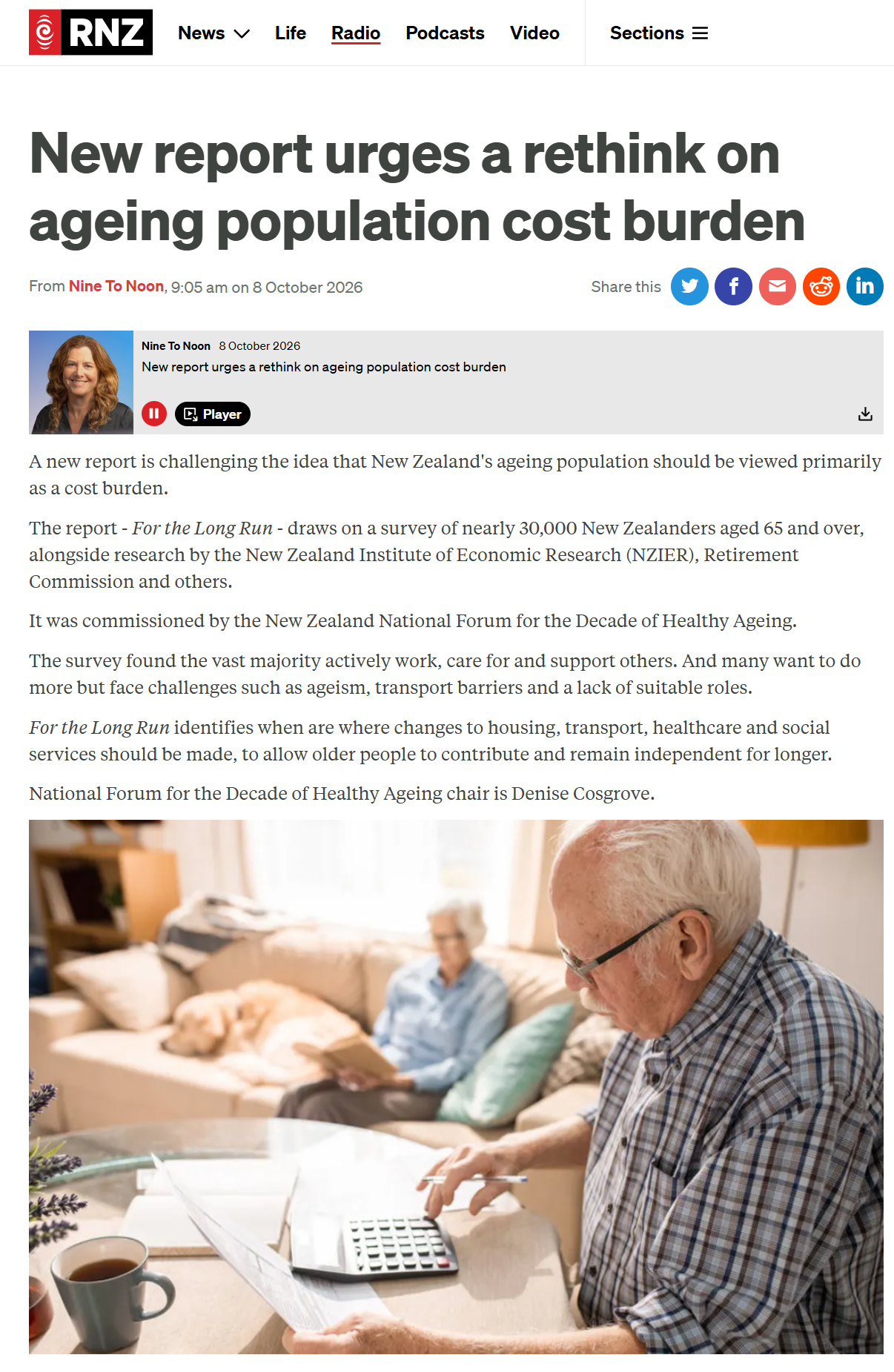
NZ’s Fastest Growing Opportunity: New Pledges Show Ways To Boost The Wellbeing, Productivity And Resilience

Five priorities for investment in longer, better, more sustainable lives

Urgent cross-sector action to support older New Zealanders to live longer, healthier and more connected lives has been called for by the Aotearoa New Zealand National Forum for the Decade of Healthy Ageing He Oranga Kaumātua, He Oranga Tangata at Parliament this morning.

Policy and decision-makers are being urged to back five transformative, yet cost-effective pledges that will support a New Zealand where everyone can thrive and age well in communities, thereby lifting wellbeing, boosting productivity and building national resilience.

The pledges are evidence-based, drawing on research by the New Zealand Institute of Economic Research (NZIER), and offer practical solutions to significant issues that are currently undermining the potential and long term opportunities arising from an ageing population: ageism, unsuitable and unaffordable housing, a lack of “whole-of-life” planning, loneliness and social isolation, and poor health outcomes.


Read more
READ MORE
29 Oct

Being awarded 'little old lady status'

Waikato times piece: 

Denise Irvine is a Hamilton freelance journalist and food writer, and a regular Waikato Times contributor.

OPINION: I had a medical appointment recently with a nurse who used relentlessly first-person plural pronouns as she stepped me through a list of questions:

“Do we know our height? What is our date of birth? Are we on any medications? Do we have any existing medical conditions? Who is our next of kin? I’ll just check our weight, can we please pop onto the scales.” And so on.


Read more
READ MORE
29 Oct

Ministerial advisory group to look at changes to aged care funding model

This from RNZ: Changes to the aged care funding model are on the cards, with a ministerial advisory group being established to make recommendations to a system the government says is out of date.

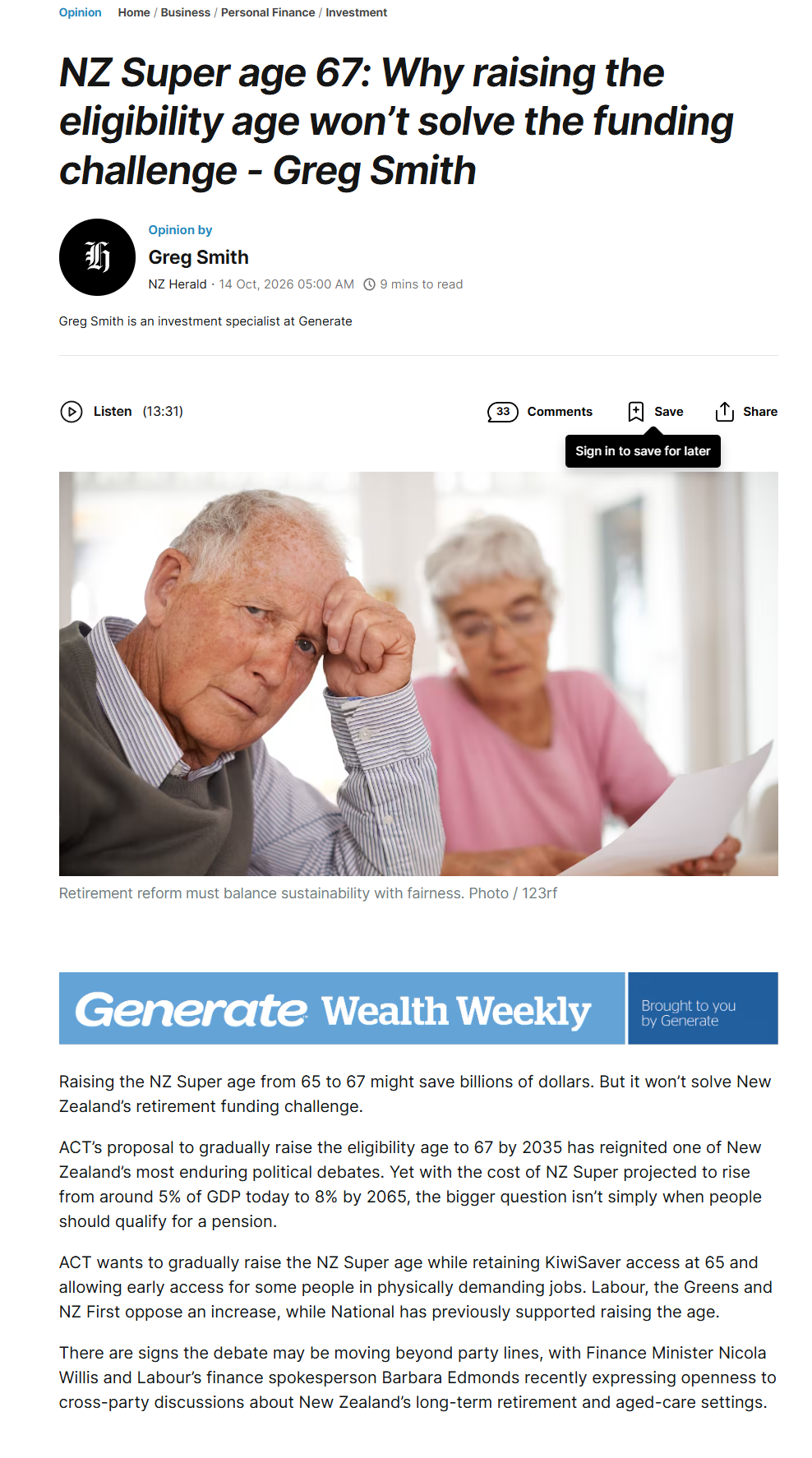
The government currently spends $2.5 billion a year on aged care, which is provided privately.

Associate Health Minister Casey Costello said there were "major political considerations" attached to any changes, and so an independent group was needed to make recommendations, as well as long-term thinking and a bipartisan approach.

She said the announcement was about better health outcomes for the 900,000 New Zealanders who were over 65, and a better, fit-for-purpose aged care system.

The number of New Zealanders aged 65 or older is expected to increase to 1.3 million by 2040.

"We know that New Zealand has very good aged care, provided by dedicated people. However, the way that these services are funded is outdated and does not recognise the connection between the various parts of the system or the future investment required," said Costello, who is also Minister for Seniors.

"Essentially, our aged care model is out of date and piecemeal change isn't the solution."


Read more
READ MORE
23 Oct

Still on the clock: No stepping off the treadmill for the over 65s

Read The Post: 

Turning 65 used to mean both a gold watch and a portal to the euphemistically-monikered “golden years” of a comfortable retirement.

Yet as life expectancy grows and living costs soar the idea of stepping off the working treadmill in your mid 60s has become increasingly unrealistic for many.

At 24% we have one of the highest rates of people aged over 65 who are still working, compared with other countries such as Australia (12%) and the UK (10%).

According to StatsNZ there are almost 200,000 working New Zealanders aged 65 or older. Almost 90,000 are aged over 70.

Certainly there’s any number of politicians, chief executives and property developers still on the tools into their 60s and 70s - and 2023 census data shows 42,000 people earning over $100,000 while collecting superannuation.


Read more

READ MORE
23 Oct

Age Concern New Zealand Supports New Report On Age-Proofing Aotearoa

This from Scoop: 

Age Concern New Zealand welcomes the findings and recommendations in the latest report from WSP and The Helen Clark Foundation, titled Age-proofing Aotearoa: Rethinking our infrastructure for an ageing population.

“We are pleased to see so many of our own priority areas addressed in this report, backed by robust data analysis. As a charity with a proud heritage leading, advocating, connecting, and collaborating to see the delivery of local services, we do not have the resources to develop such an in-depth data analysis ourselves. We see this as an extremely valuable contribution for decision-makers,” says Karen Billings-Jensen, Chief Executive, Age Concern New Zealand.

At today’s report release at Parliament, Kali Mercier, WSP Fellow and Deputy Director of the Helen Clark Foundation, asked guests to consider their age in 2048, when some regions will be experiencing ‘hyper-ageing’, with 30% of residents expected to be aged 65. “It was a valuable reflection of the future, with some decision-makers present aged over 65 around that time. Their decisions now will be personal for them in 23 years” says Mrs Billings-Jensen.


Read more

READ MORE
21 Oct

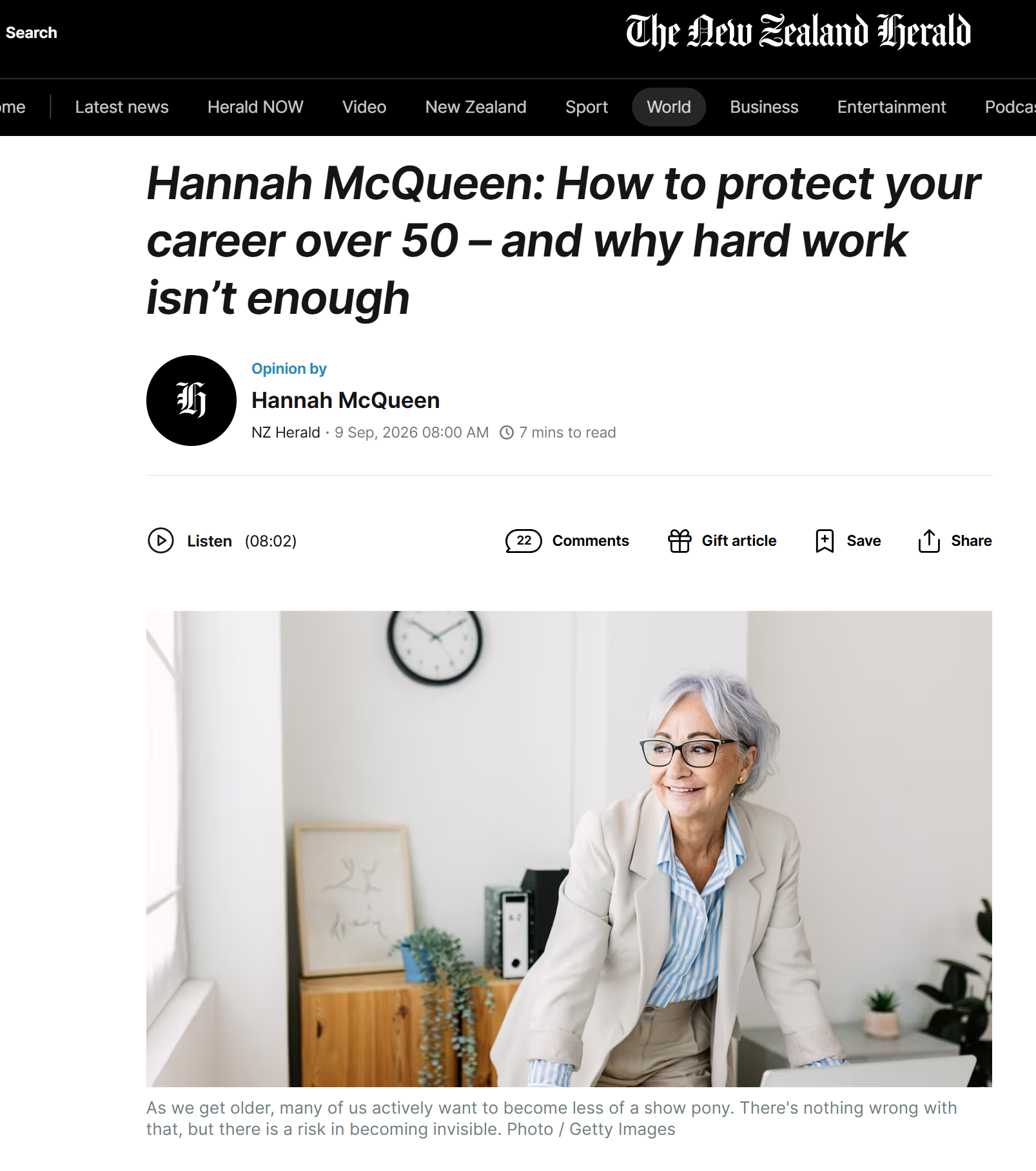
Who said women over 50 had to be invisible?

I’ve long felt uncomfortable with the idea that women become invisible with age; that now I’m in my 50s, I should be prepared to fade from view. Is that really how it is?

When I asked other women in my Gen X cohort about their experiences, they shared more than one tale of apparent physical invisibility with me: “I had my first experience of invisibility last week – I was standing at a counter ready to purchase, and two other people (who were standing behind me) got served first”, said one woman. Another shared something similar, adding “It surprised me as I am tall and very hard to overlook!”

Some women have experienced it showing up in working life: “I’m definitely feeling invisible in the job market at the moment,” one woman told me. “I have applied for over 30 jobs in the last three months, and not a nibble back. I’m not sure if it’s just the job market, gender, age, seniority…. or all of the above.”


Read more
READ MORE
21 Oct

Innovative Māori aged care model set to bring aroha, manaakitanga to kaumātua

Aged care in Aotearoa New Zealand is in crisis. Reports of staff being underpaid and over worked are common as are the reports of elderly residents not getting the care they should. Kaitiaki is exploring what’s happening in this space. We talk with a granddaughter who is on a mission to transform aged care for Māori, starting with kaumātua from her own tribe.


Read more

READ MORE
21 Oct

Air New Zealand pilot wins age discrimination case

A pilot who claimed Air New Zealand discriminated against him because of his age has succeeded in a personal grievance claim against the airline.

Captain Garth McGearty took the claim against Air New Zealand to the Employment Court, after he was turned down by the Employment Relations Authority, alleging unjustified disadvantage and unlawful discrimination because of age.

The NZ Airline Pilots Association (NZALPA) was also involved because the issues for determination involved interpretation of the union's collective agreement.

McGearty had reached the most senior rank, as captain of the Boeing 777.

He turned 65 in July 2017.


Read more

Our Collaborators

Organisations we work with

Davis Funnerals logoWhau local boardDementia Auckland logoUniversity of AucklandKristin School logoMacular Degeneration New ZealandACC Stronger for LongerGlaucoma NZ logoTe Uru Tangata  - Workplace inclusion Kahui Tu Kaha

Charity Name: Age Concern Auckland Trust
Registration Number: CC60750

What we do - Services
    Say hello

    09-820-0184

    ageconcern@ageconak.org.nz

    57 Rosebank Road, Avondale, Auckland 1026

    Monday-Friday 9am-4pm

    SUBSCRIBE
       WE WONT SPAM YOU


    All Rights Reserved. © 2025 Age Concern Auckland